
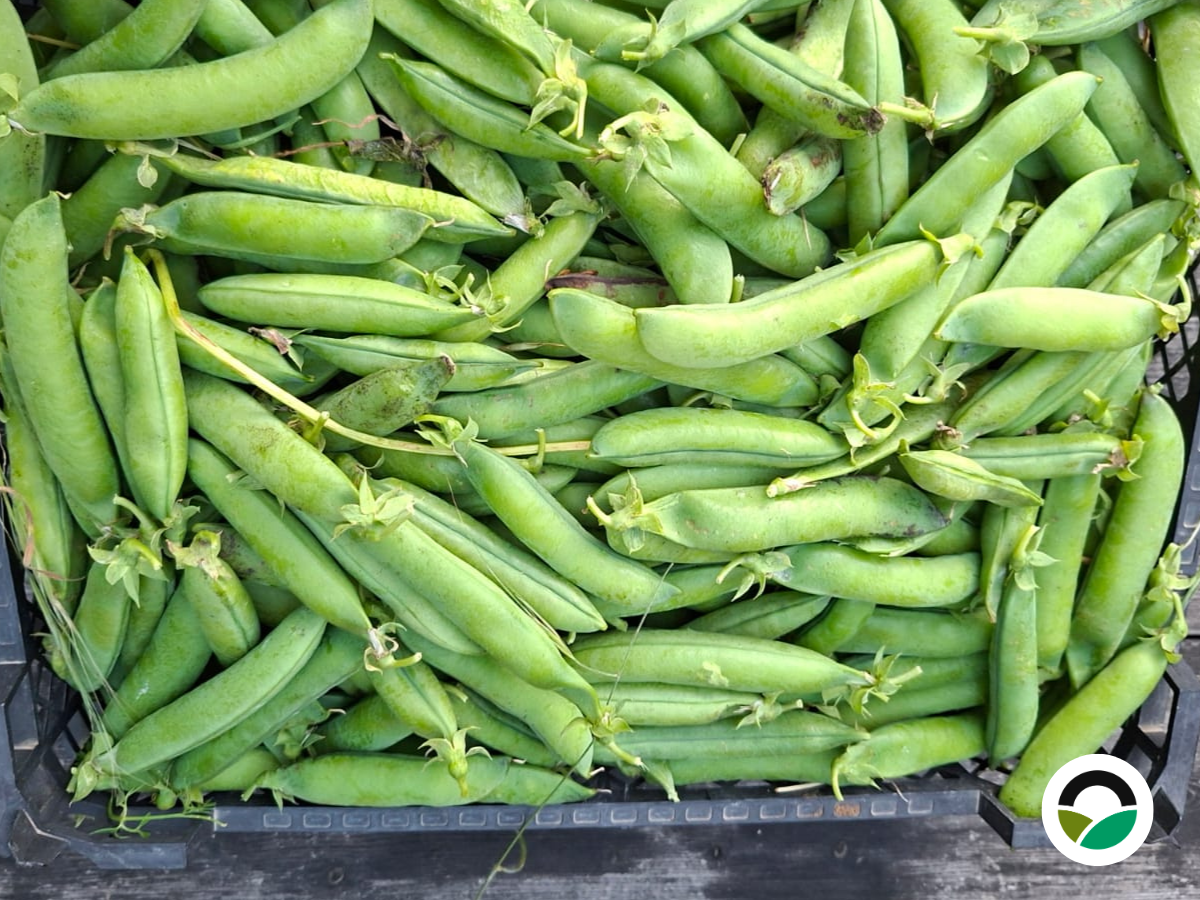
At Mavronero, the harvest is not an isolated moment but the result of a process that begins months earlier. The peas now being collected were sown in October and December, establishing during the cooler months and developing gradually under seasonal conditions.
Their harvest in spring reflects a cultivation approach based on timing, patience, and alignment with the natural cycle.
Morphological characteristics
Peas (Pisum sativum) are annual climbing plants belonging to the Fabaceae family. They are characterized by their tendrils, which allow them to attach to surrounding structures, and by their compound leaves adapted to efficient light capture.
Key characteristics include:
- herbaceous climbing growth supported by tendrils
- compound leaves with multiple leaflets
- production of pods containing multiple seeds
- relatively fast development under suitable conditions
- adaptation to cool-season growth
These traits make peas particularly suitable for autumn sowing in Mediterranean climates.
Growth cycle and seasonal development
The peas cultivated at Mavronero follow a seasonal cycle that takes advantage of natural environmental conditions.
The process includes:
- autumn sowing (October–December), allowing early establishment
- winter development, supported by soil moisture and moderate temperatures
- spring flowering and pod formation
- harvest during peak productivity in spring
This cycle reduces the need for intensive inputs, as plants grow in conditions that naturally support their development.
Harvesting process
The harvest is carried out entirely by hand, pod by pod. This method allows for selective picking, ensuring that only mature pods are collected while others continue to develop.
Beyond its practical function, manual harvesting creates a direct connection between the person and the plant. It is a slow and repetitive process, but also a highly satisfying one, as the results of months of growth become visible.
This approach maintains the integrity of the plants and minimizes disturbance within the system.
Ecological role
As members of the Fabaceae family, peas play an important role beyond food production.
Their ecological contributions include:
- nitrogen fixation through symbiosis with soil bacteria
- improvement of soil fertility for subsequent crops
- support of soil biological activity
- contribution to crop rotation systems
This dual function — production and soil enrichment — makes peas a key component in agroecological practices.
Observations at Mavronero
The current harvest reflects a successful growing season. Plants have developed consistently, producing a significant number of pods across the cultivated area.
Notable observations include:
- strong plant development during winter months
- abundant pod formation in spring
- efficient use of seasonal rainfall and temperature
- high level of productivity without intensive intervention
The result is not only a productive harvest, but also a clear indication of system stability.
Integration within the system
At Mavronero, pea cultivation is integrated within a broader agroecological system where crops, soil, and seasonal cycles interact continuously.
Rather than maximizing short-term output, the focus is on:
- aligning planting with seasonal conditions
- maintaining soil health over time
- reducing external inputs
- supporting long-term productivity
In this context, the harvest is part of an ongoing cycle rather than an endpoint.
Conclusion
The harvest of peas (Pisum sativum) at Mavronero demonstrates how timing, simplicity, and ecological understanding can lead to both productivity and satisfaction.
From autumn sowing to spring harvest, the process reflects a system that works with natural conditions rather than against them. The result is not only food, but also improved soil and a stronger, more resilient agricultural environment.
