
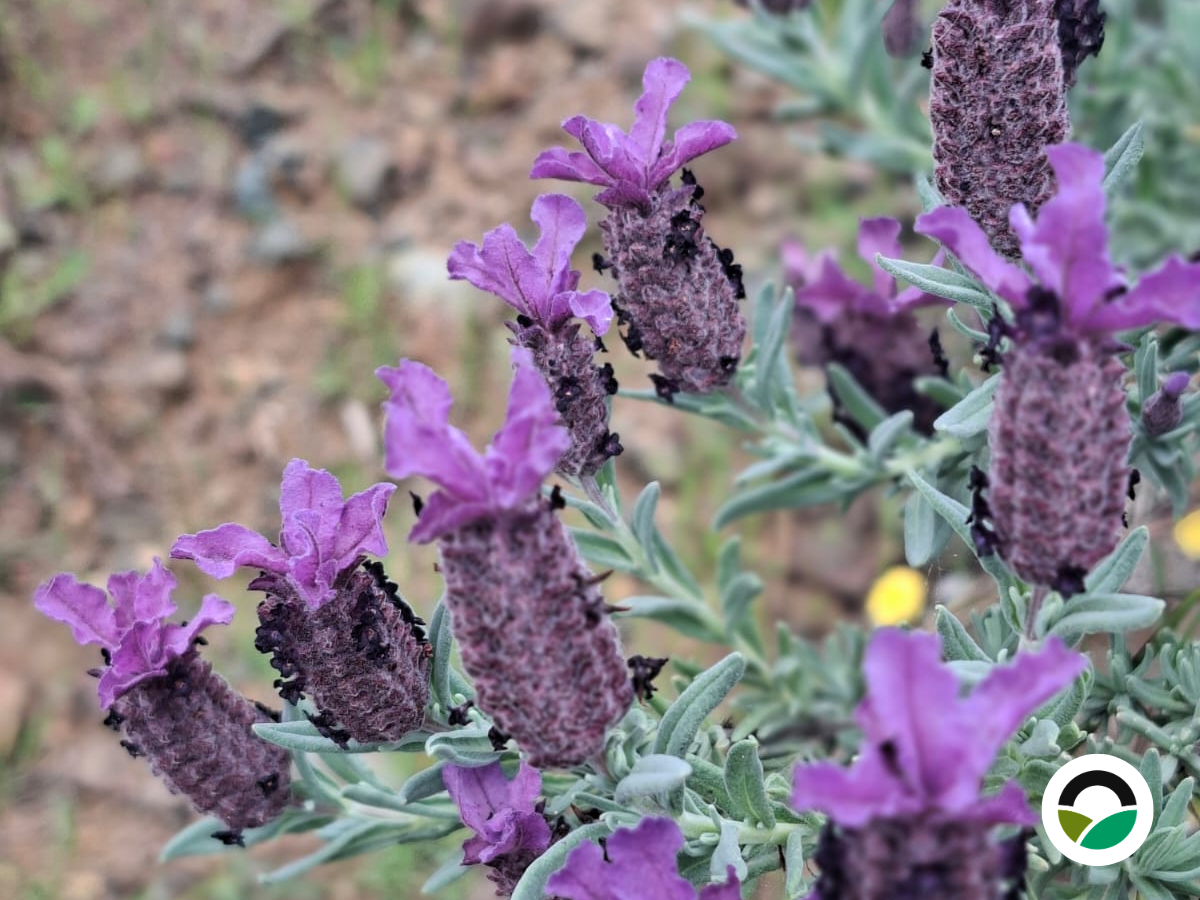
At Mavronero, the presence of aromatic species is not incidental but part of a broader ecological approach to cultivation. French lavender (Lavandula stoechas) is one of the plants that naturally integrates into this system, contributing to both environmental stability and biological diversity.
Its flowering period represents a phase where plant structure, environmental adaptation, and ecological interactions become particularly visible.
Morphological characteristics
French lavender is a perennial shrub belonging to the Lamiaceae family, well adapted to Mediterranean climates characterized by dry conditions and high solar exposure.
The plant exhibits a compact, woody structure with narrow grey-green leaves that reduce water loss. Its most distinctive feature is the flower head, composed of dense inflorescences topped with purple bracts, which play a key role in attracting insects.
This morphology reflects a balance between resilience and functionality, allowing the plant to thrive with minimal external inputs.
Flowering and pollinator activity
During the flowering stage, French lavender becomes an active site of ecological interaction. The flowers produce both nectar and aromatic compounds that attract insects.
At Mavronero, small insects can be observed visiting the flower heads, moving across the inflorescences in a pattern consistent with pollination behavior. While the exact species cannot be precisely identified, their activity indicates ongoing pollination processes.
This interaction is essential not only for the reproductive cycle of the plant but also for supporting local insect populations. Flowering plants such as lavender act as resources within the ecosystem, providing food and contributing to the stability of pollinator networks.
Ecological role within the system
Beyond its individual growth, French lavender contributes to multiple ecological functions:
- supporting pollinator activity
- increasing biodiversity within cultivated and semi-wild areas
- thriving in low-input conditions with minimal intervention
- contributing to the overall balance of the ecosystem
Its presence enhances the system not through productivity alone, but through its interactions with surrounding organisms.
Observations at Mavronero
Current observations show that French lavender is well established and adapted to local conditions.
The plants display stable growth and consistent flowering, even under limited irrigation and natural soil conditions. The visible presence of insects on the flowers confirms active ecological interactions taking place within the site.
These observations highlight the plant’s ability to function effectively within a low-intervention cultivation model.
Integration within the cultivation approach
At Mavronero, plants like French lavender are not treated as isolated elements but as part of an interconnected system.
Rather than focusing solely on yield, the emphasis is placed on:
- supporting biodiversity
- encouraging natural interactions between species
- maintaining system resilience over time
- working with environmental conditions rather than modifying them
In this context, flowering becomes an indicator of ecological health rather than simply a stage of plant development.
Conclusion
The flowering of French lavender at Mavronero illustrates how a single species can contribute to a wider ecological framework.
Through its adaptation to local conditions and its interaction with pollinating insects, it reinforces a cultivation approach based on observation, simplicity, and balance.
What may appear as a small and isolated event—the blooming of a plant—reveals, in reality, the presence of an active and interconnected system.
