
Some of nature’s most remarkable flowers bloom for only a short time, making every observation a special event.
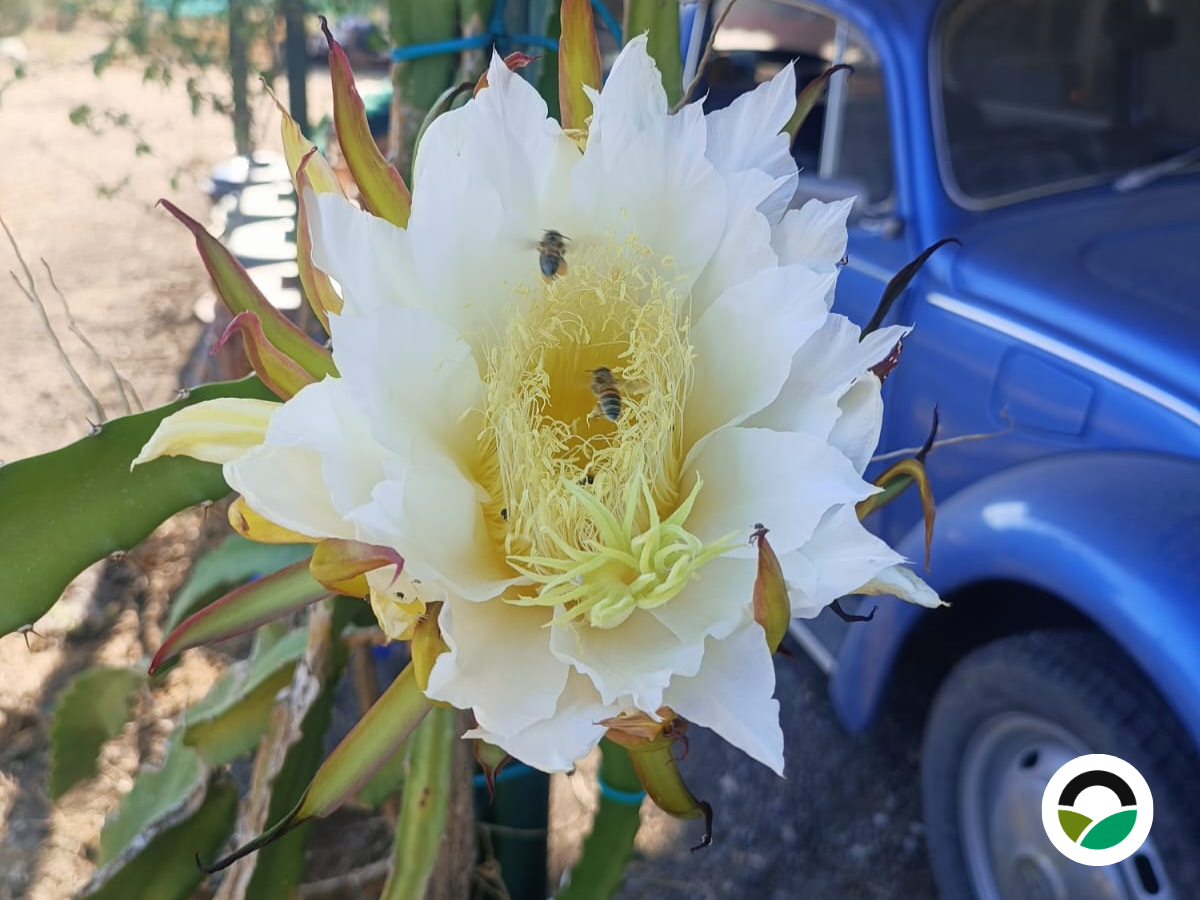
During the summer of 2026, we documented the spectacular flower of the dragon fruit cactus (Selenicereus undatus) at Mavronero Farm. Its large white blossom attracted several honey bees (Apis mellifera), illustrating the essential relationship between flowering plants and their pollinators.
Although the bloom remains open for less than a day, it represents one of the most important stages in the plant’s life cycle. Without successful pollination, there would be no dragon fruit.
A cactus unlike any other
Dragon fruit belongs to the cactus family (Cactaceae), yet it looks very different from the desert cacti most people are familiar with.
Native to Central America and now cultivated throughout tropical and subtropical regions, Selenicereus undatus is a climbing cactus with long, triangular stems that grow by attaching themselves to trees, posts or other supporting structures.
Unlike many cacti, it is grown primarily for its colourful edible fruit rather than for ornamental purposes.
A flower that blooms for less than a day
The flowers of the dragon fruit are among the largest produced by any cactus.
Large, fragrant and bright white, they usually begin opening around sunset and remain fully open throughout the night before gradually closing the following morning.
This extremely short flowering period makes pollination a race against time.
Each flower has only one opportunity to be successfully pollinated before it begins to wither.
Pollinators at work
In its native range, dragon fruit flowers are mainly pollinated by nectar-feeding bats and large nocturnal moths that visit the flowers during the night.
However, because the flowers often remain open into the early morning, honey bees (Apis mellifera) and other daytime insects may also visit them while collecting pollen or nectar.
The bees observed at Mavronero Farm demonstrate how different pollinators can contribute to the reproductive success of flowering plants, particularly in cultivated landscapes.
Without pollinators, fruit production would be greatly reduced or may not occur at all.
From flower to fruit
Every dragon fruit begins as a single successful flower.
Once pollination occurs, the flower gradually withers while the ovary beneath it begins to develop into the familiar brightly coloured fruit.
Over the following weeks, the fruit enlarges before eventually reaching maturity.
This transformation from a short-lived flower into an edible fruit highlights the remarkable efficiency of plant reproduction.
Observations at Mavronero
These photographs were taken during the summer of 2026 while documenting flowering plants at Mavronero Farm.
Several honey bees were observed actively visiting a newly opened dragon fruit flower during the morning, collecting pollen while the flower remained open.
The observation highlights the close relationship between cultivated plants and pollinating insects, reminding us that productive agriculture depends on healthy ecosystems and thriving biodiversity.
Interesting facts
Dragon fruit (Selenicereus undatus)
- Member of the cactus family (Cactaceae).
- Native to Central America and widely cultivated around the world.
- Produces one of the largest flowers of any cactus species.
- Flowers usually open at sunset and close during the following morning.
- Individual flowers remain open for less than 24 hours.
- Pollinated by bats, moths, bees and other insects depending on the region.
- Every fruit develops from a successfully pollinated flower.
- Can continue producing flowers throughout the warm growing season.
The importance of pollination
Flowering plants and pollinators have evolved together over millions of years.
Bees, butterflies, moths, birds and bats all play essential roles in transferring pollen between flowers, allowing plants to produce seeds and fruits.
Supporting pollinator populations through healthy habitats and regenerative farming practices benefits both biodiversity and agricultural production.
Every successful flower represents a small but essential interaction within a much larger ecosystem.
Conclusion
The dragon fruit flower is one of nature’s most spectacular yet short-lived displays.
Its brief flowering period reminds us how closely successful food production depends on pollinators and healthy ecosystems.
By observing these natural interactions at Mavronero Farm, we gain a deeper appreciation of the biodiversity that supports regenerative agriculture.
