
Some of the most valuable observations in regenerative farming happen when nature carries on undisturbed.
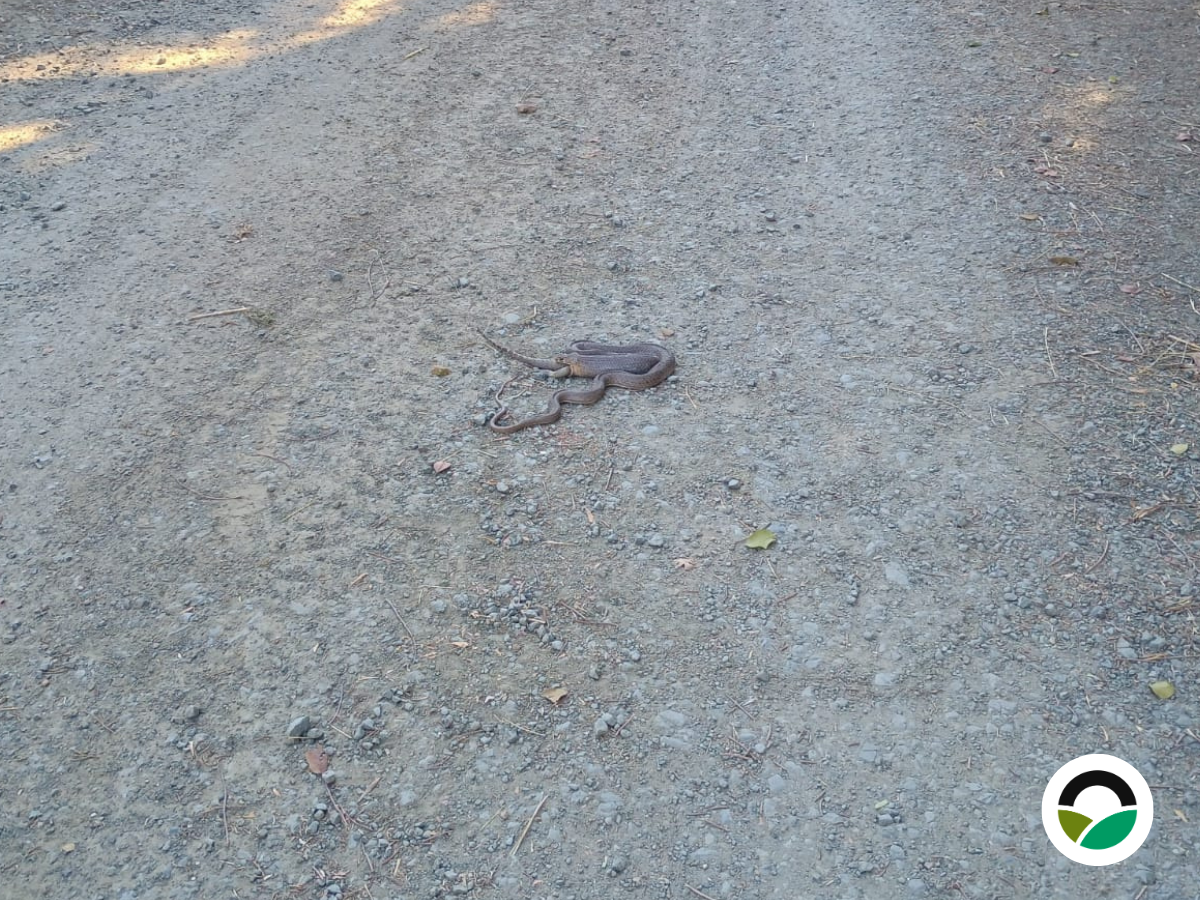
During a recent walk through Mavronero Farm, we came across a fascinating wildlife interaction: a snake feeding on a Cyprus agama (Laudakia cypriaca), locally known as “kourkouda.”
Although scenes like this may appear dramatic, they are a natural part of healthy ecosystems. Every predator and every prey species contributes to maintaining ecological balance, supporting food webs that have evolved over thousands of years.
At Mavronero, documenting these moments helps us better understand the biodiversity that surrounds us and the ecological processes taking place beyond our cultivated crops.
Predators play an essential ecological role
Snakes are important predators in Mediterranean ecosystems.
They naturally regulate populations of reptiles, rodents and other small animals, helping maintain balanced food webs without human intervention. By controlling prey populations, they contribute to healthier and more resilient ecosystems.
Predators are often overlooked, yet they are essential indicators of a functioning landscape where natural ecological relationships remain intact.
The Cyprus agama
The Cyprus agama (Laudakia cypriaca), commonly known in Cyprus as “kourkouda,” is one of the island’s most familiar reptiles.
This endemic lizard is frequently seen basking on rocks, stone walls and dry landscapes during the warmer months. It feeds mainly on insects and other small invertebrates, making it an important natural controller of insect populations.
Like many native reptiles, it also forms part of the diet of larger predators, illustrating the interconnected nature of Mediterranean ecosystems.
Biodiversity beyond cultivation
Regenerative agriculture is about much more than producing food.
Healthy farms provide habitat for countless species that interact in complex ecological networks. Pollinators, decomposers, birds, reptiles and predators all contribute to ecosystem resilience.
Observing these interactions reminds us that biodiversity is not static, it is constantly changing through natural processes such as predation, competition and reproduction.
Observations at Mavronero
This encounter was observed on one of the farm tracks during routine work.
Rather than disturbing the animals, we simply documented the moment before continuing on our way, allowing nature to follow its course.
Every wildlife observation recorded at Mavronero contributes to our understanding of the diverse species that share this landscape and highlights the importance of protecting functioning ecosystems.
Interesting facts
Cyprus agama (Laudakia cypriaca)
- Endemic to Cyprus and found across rocky, dry Mediterranean habitats.
- Feeds mainly on insects and other small invertebrates.
- Frequently basks on rocks, walls and exposed ground to regulate body temperature.
- Serves both as a predator of insects and as prey for larger animals, including snakes and birds of prey.
- Plays an important role in maintaining balanced food webs.
Every observation tells a story
Wildlife encounters like this remind us that regenerative farming works alongside nature rather than against it.
Predator-prey interactions are essential ecological processes that have shaped ecosystems for millions of years. Although they may seem harsh from a human perspective, they help maintain healthy populations and resilient landscapes.
At Mavronero Farm, every observation, from the smallest insect to larger wildlife, helps us better understand, appreciate and protect the biodiversity that makes Mediterranean ecosystems so unique.
Conclusion
Finding a snake feeding on a Cyprus agama was a powerful reminder that healthy ecosystems are built on countless natural interactions.
By allowing wildlife to thrive alongside regenerative farming practices, we help support the ecological balance that sustains biodiversity over the long term.
Sometimes, the most memorable moments on the farm are simply nature doing what it has always done.
