
Introduction
At Mavronero, the planting of cherry tomatoes marks the beginning of one of the most productive phases of the growing season. This stage connects earlier propagation methods with field cultivation, bringing together preparation, timing, and technique.
This season, approximately 44 tomato plants from two different varieties have been transplanted into the field, following a method designed to support strong root development and long-term resilience.
Morphological characteristics
Cherry tomatoes (Solanum lycopersicum) are annual plants belonging to the Solanaceae family. They are characterized by vigorous vegetative growth and a high capacity for fruit production under suitable conditions.
Key characteristics include:
- herbaceous growth with indeterminate or semi-determinate structure
- compound leaves with high photosynthetic capacity
- ability to develop adventitious roots along the stem
- production of small fruits in clusters (cherry-type)
- sensitivity to temperature, water availability, and soil conditions
One of their most important traits is their ability to form additional roots when the stem is buried, a feature that directly informs planting techniques.
Propagation and early development
Before being transplanted into the field, the tomato seedlings were grown using soil blocks. This method allows roots to develop freely and promotes a more stable transition when plants are moved into the soil.
As a result, seedlings are better prepared to adapt to field conditions, with reduced stress and improved initial establishment.
Planting method
The planting process at Mavronero follows a structured but low-intervention approach.
Key steps include:
- preparation of planting holes approximately 15–20 cm deep
- addition of mushroom compost to enrich the soil
- application of a large amount of water before planting
- placement of seedlings into the holes
- covering part of the stem with soil
The depth of planting is a critical factor. By burying a portion of the stem, the plant is encouraged to develop additional roots along its length, increasing its capacity to absorb water and nutrients.
The addition of mushroom compost improves soil structure and nutrient availability, while the initial watering ensures adequate moisture for root establishment.
Growth conditions and system setup
The tomato plants are arranged in rows, allowing for efficient irrigation and future plant management. Drip irrigation lines provide water directly to the root zone, reducing losses and maintaining stable moisture conditions.
A vertical support structure is installed above the planting area. As the plants grow, they will be guided upward, improving:
- light exposure
- air circulation
- plant health
- ease of harvesting
This system supports both productivity and long-term plant stability.
Ecological role
Beyond their role as a productive crop, tomatoes contribute to the broader agroecosystem.
Their ecological functions include:
- supporting pollinators during flowering
- contributing organic matter through plant residues
- interacting with soil microorganisms
- forming part of a diverse cropping system
When managed within an integrated system, tomatoes can coexist with other crops while contributing to overall ecological balance.
Observations at Mavronero
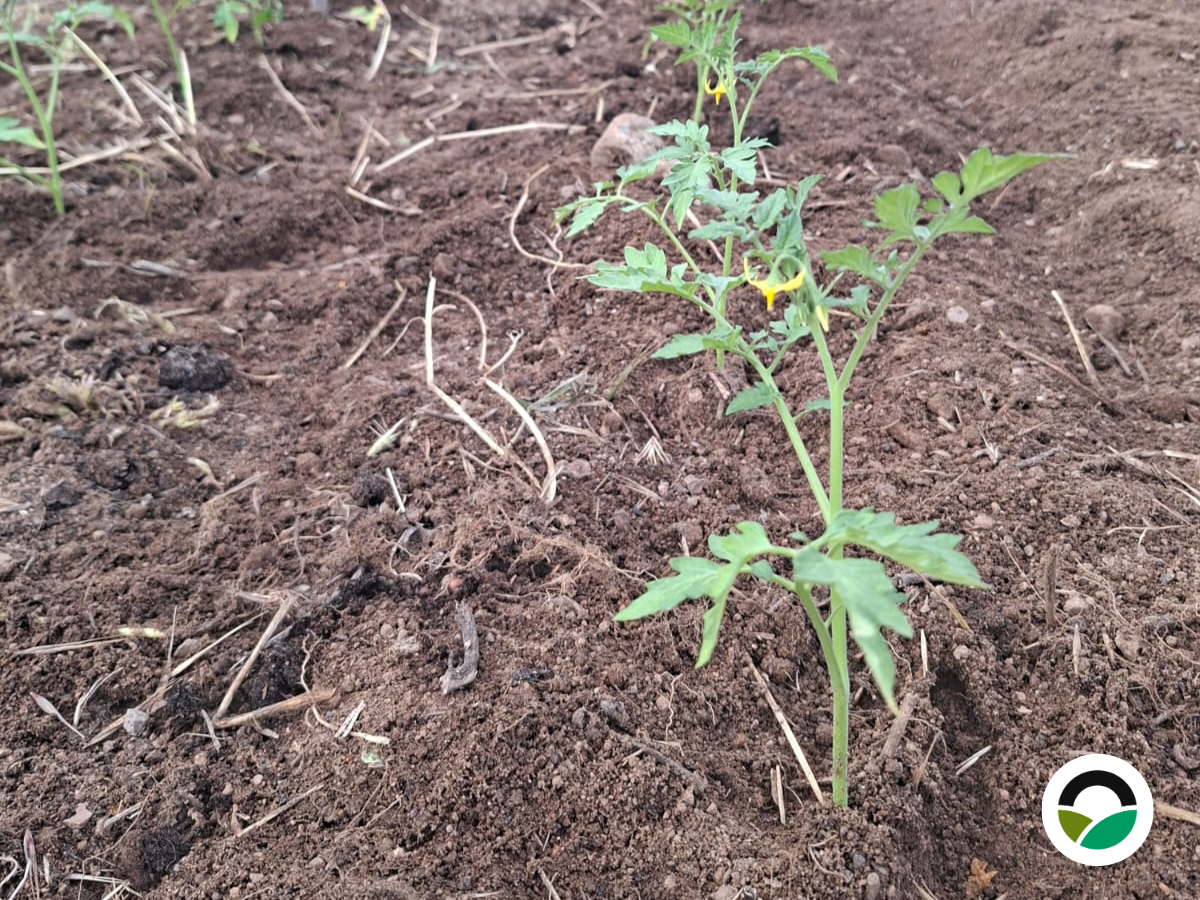
At this stage, the plants are recently transplanted and beginning to establish in the soil. Early signs of adaptation include upright growth, leaf expansion, and initial flowering in some individuals.
Notable aspects include:
- consistent planting layout across approximately 44 plants
- presence of two different tomato varieties
- well-prepared planting holes with organic amendments
- strong initial hydration conditions
These factors indicate a well-planned transition from propagation to field growth.
Integration within the system
The planting of tomatoes at Mavronero reflects a broader approach based on working with natural processes rather than intensifying inputs.
This includes:
- supporting root development through planting techniques
- improving soil conditions with organic matter
- optimizing water use through targeted irrigation
- allowing plants to develop within seasonal conditions
Such integration supports resilience and long-term productivity.
Conclusion
The planting of cherry tomatoes (Solanum lycopersicum) at Mavronero demonstrates how careful preparation and simple techniques can significantly influence plant development.
From soil block propagation to deep planting with compost and water, each step contributes to building a strong foundation for the growing season.
As the plants develop, this initial investment in structure and conditions will shape their productivity, resilience, and role within the broader agricultural system.
