
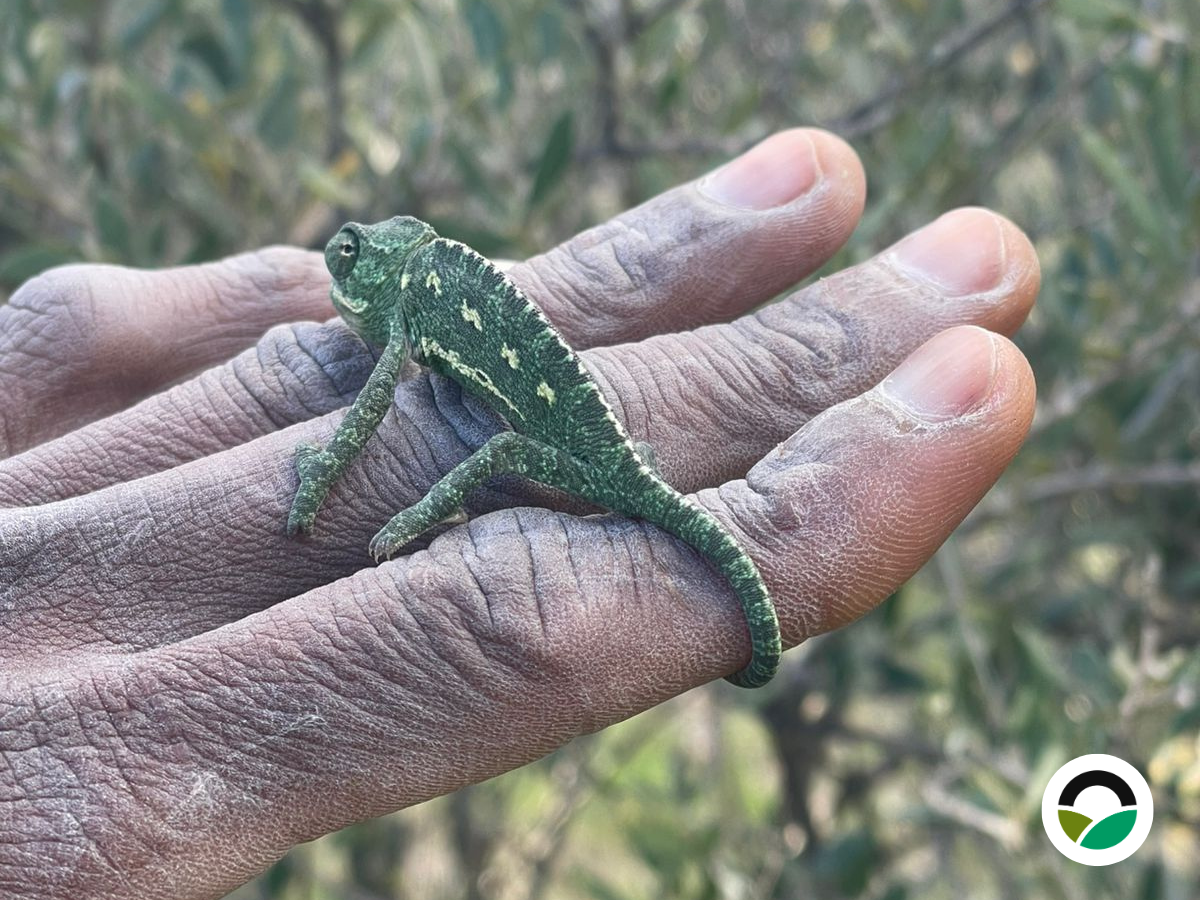
The common chameleon (Chamaeleo chamaeleon) is one of the most remarkable reptiles found in Mediterranean ecosystems. Known for its slow movements, independently moving eyes, and ability to change colour, this species is highly specialized for life among shrubs and trees.
At Mavronero Farm, chameleons occasionally appear in the olive grove, moving carefully through branches in search of insects. Their camouflage makes them difficult to detect, and encounters usually occur only when walking slowly through the vegetation.
Observations like this highlight how agricultural landscapes can support wildlife when vegetation structure and ecological balance are maintained.
Species description
The common chameleon belongs to the reptile family Chamaeleonidae, a group adapted to life in trees and shrubs.
Adult individuals usually reach around 20–30 cm in total length, including the tail. The body is laterally compressed, allowing the animal to move easily through dense vegetation.
Some of the most distinctive characteristics include:
- independently moving eyes
- zygodactyl feet adapted for gripping branches
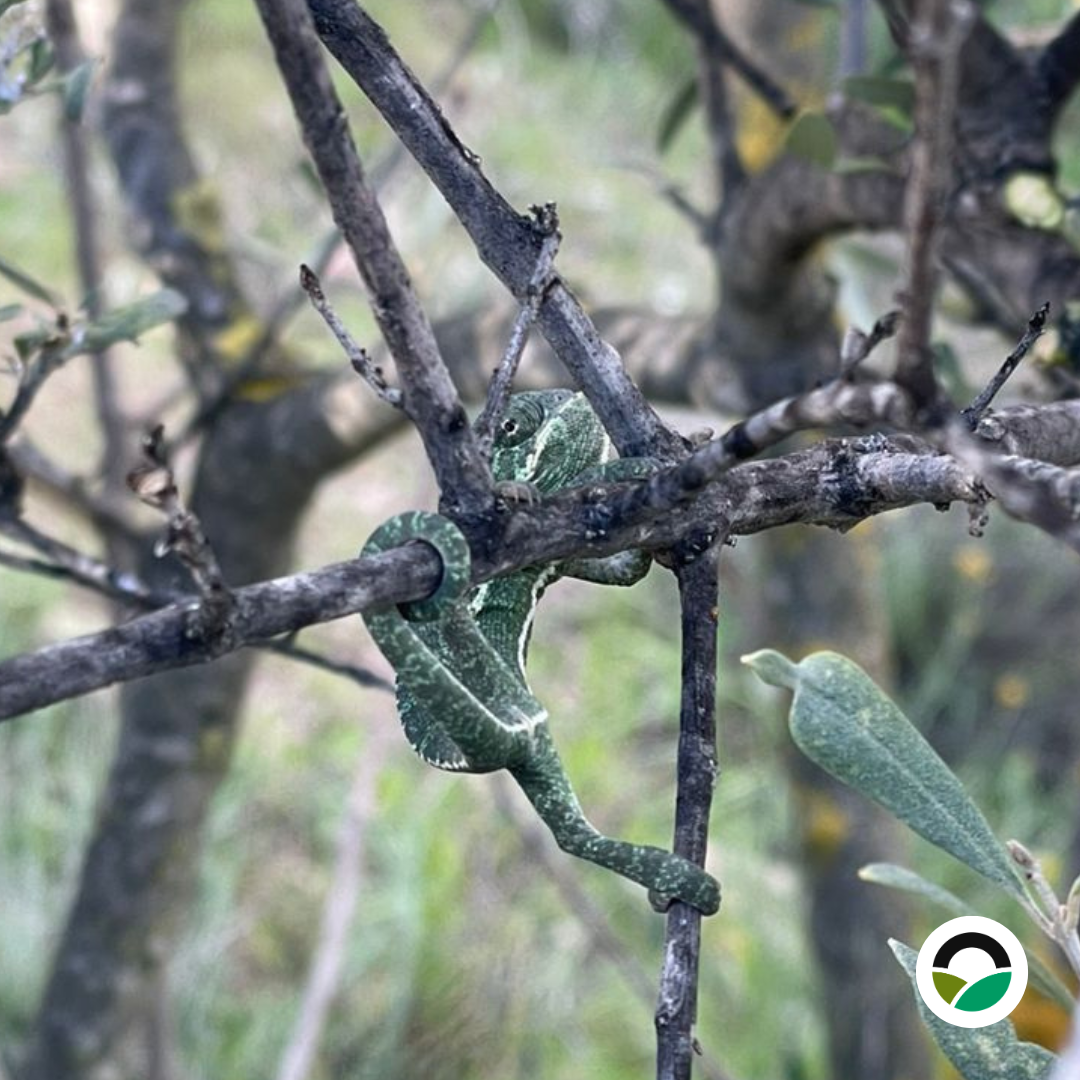
- a prehensile tail used for stability while climbing
- the ability to change colour depending on temperature, light, and behaviour
Their movement is slow and deliberate, often mimicking the natural sway of leaves in the wind.
Habitat and distribution
The common chameleon (Chamaeleo chamaeleon) is native to the Mediterranean region.
It can be found in several areas including:
- Greece
- Cyprus
- Southern Spain and Portugal
- North Africa
- Parts of the Middle East
Typical habitats include Mediterranean shrublands, coastal vegetation, orchards, and olive groves.
Traditional olive groves with natural undergrowth provide excellent habitat conditions because they offer perching branches, warm microclimates, and abundant insect populations.
Agricultural landscapes that preserve vegetation diversity often support a surprising variety of reptiles and other wildlife.
Behaviour and diet
The common chameleon is primarily insectivorous.
Its diet includes a wide range of small invertebrates such as:
- flies
- grasshoppers
- beetles
- moths
- spiders
Rather than actively chasing prey, chameleons rely on patience and camouflage. They remain almost motionless until an insect approaches within reach.
Their most remarkable hunting adaptation is the projectile tongue, which can extend extremely quickly to capture prey.
Chameleons are generally solitary animals and rely on stealth rather than speed when avoiding predators.
Adaptations and physiology
The common chameleon possesses several highly specialized adaptations that allow it to thrive in arboreal environments.
Vision
Chameleons have exceptional eyesight. Their eyes can rotate independently, allowing them to observe two different areas simultaneously.
When prey is detected, both eyes focus forward to accurately judge distance before striking.
Tongue mechanics
The tongue of a chameleon can extend to a distance longer than its own body length.
Specialized muscles store elastic energy that allows the tongue to launch extremely rapidly toward prey.
The tip of the tongue contains a sticky pad that secures insects during capture.
Colour change
Colour change in chameleons is often misunderstood. While it can contribute to camouflage, it is mainly used for:
- thermoregulation
- communication
- stress response
- behavioural signalling
Specialized skin cells called chromatophores control colour changes by reflecting different wavelengths of light.
Reproduction and life cycle
The breeding season for the common chameleon typically occurs during the warmer months.
Males become more active and may display colour changes during interactions with females or rival males.
After mating, the female lays 20–40 eggs in the soil, usually in a carefully dug underground nest. The eggs remain buried during incubation.
Depending on environmental conditions, incubation may last several months, and the young hatch fully independent.
Juvenile chameleons resemble miniature adults and begin hunting insects shortly after emerging.
Ecological role
Although often overlooked, chameleons play an important role in the ecological balance of Mediterranean ecosystems.
By feeding on insects and other small arthropods, they help regulate populations of various invertebrates.
In agricultural landscapes such as olive groves, this natural predation contributes to biological pest control.
The presence of reptiles like chameleons often indicates relatively healthy habitats where vegetation structure is preserved, insect populations remain stable, and chemical disturbance is limited.
Conservation and threats
Although the common chameleon still occurs across parts of the Mediterranean, several pressures affect its populations.
Major threats include:
- habitat loss due to urban expansion
- removal of natural vegetation
- pesticide use reducing insect populations
- road mortality
- illegal collection for the pet trade
Protecting diverse landscapes that include shrubs, trees, and natural vegetation corridors is essential for maintaining suitable habitats for this species.
Curiosities
The common chameleon possesses several fascinating characteristics that make it one of the most unique reptiles in the Mediterranean region.
- Its eyes can rotate almost 180 degrees independently, providing nearly panoramic vision.
- The tongue can accelerate extremely quickly, making it one of the fastest movements in the animal kingdom.
- The tail acts almost like a fifth limb, helping stabilize the animal while climbing.
- Their slow walking movement helps them mimic the motion of leaves in the wind, improving camouflage.
Observing chameleons in olive groves
Chameleons are often present but rarely seen.
Their camouflage allows them to blend perfectly with branches and leaves.
They are most often observed:
- resting on sunlit branches
- slowly moving through shrubs
- perched quietly among olive branches
Walking slowly and carefully through vegetation greatly increases the chances of spotting one.
If encountered, it is best to observe them briefly and allow them to remain undisturbed.
Notes from Mavronero
Encounters with wildlife in the olive grove are always unexpected.
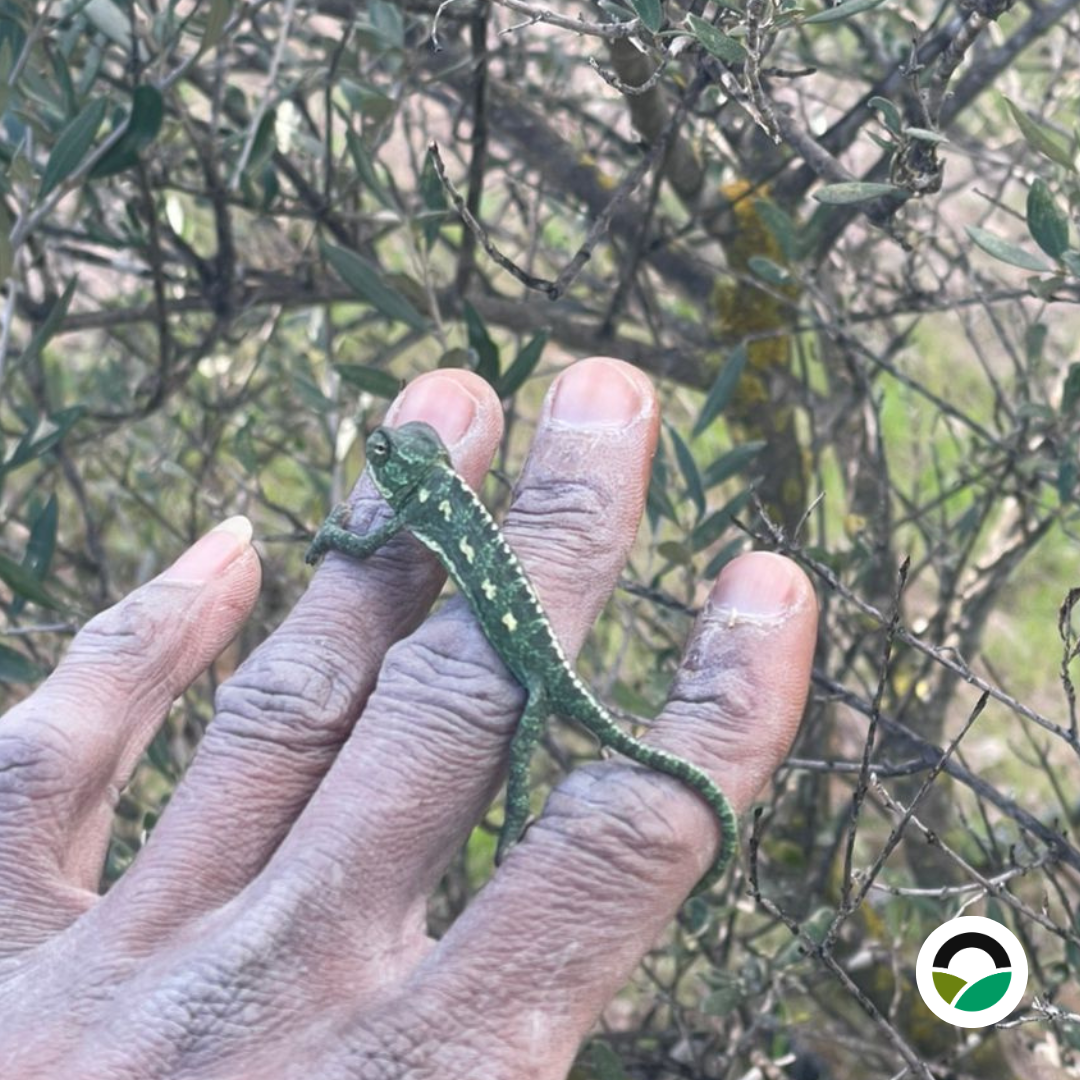
This chameleon was first noticed quietly resting among olive branches, almost perfectly blending into the surrounding vegetation. Only after careful observation did its shape become visible among the branches.
After approaching slowly, it briefly climbed onto a hand before returning to the olive tree.
Moments like this remind us that agricultural landscapes can coexist with wildlife. Farms that maintain diverse vegetation and minimize disturbance can become refuges for many species that share the Mediterranean landscape.
Sources
International Union for Conservation of Nature (IUCN) – Chamaeleo chamaeleon species assessment
Animal Diversity Web – Chamaeleo chamaeleon overview and biology
Reptile Database – taxonomic information about Chamaeleo chamaeleon
