

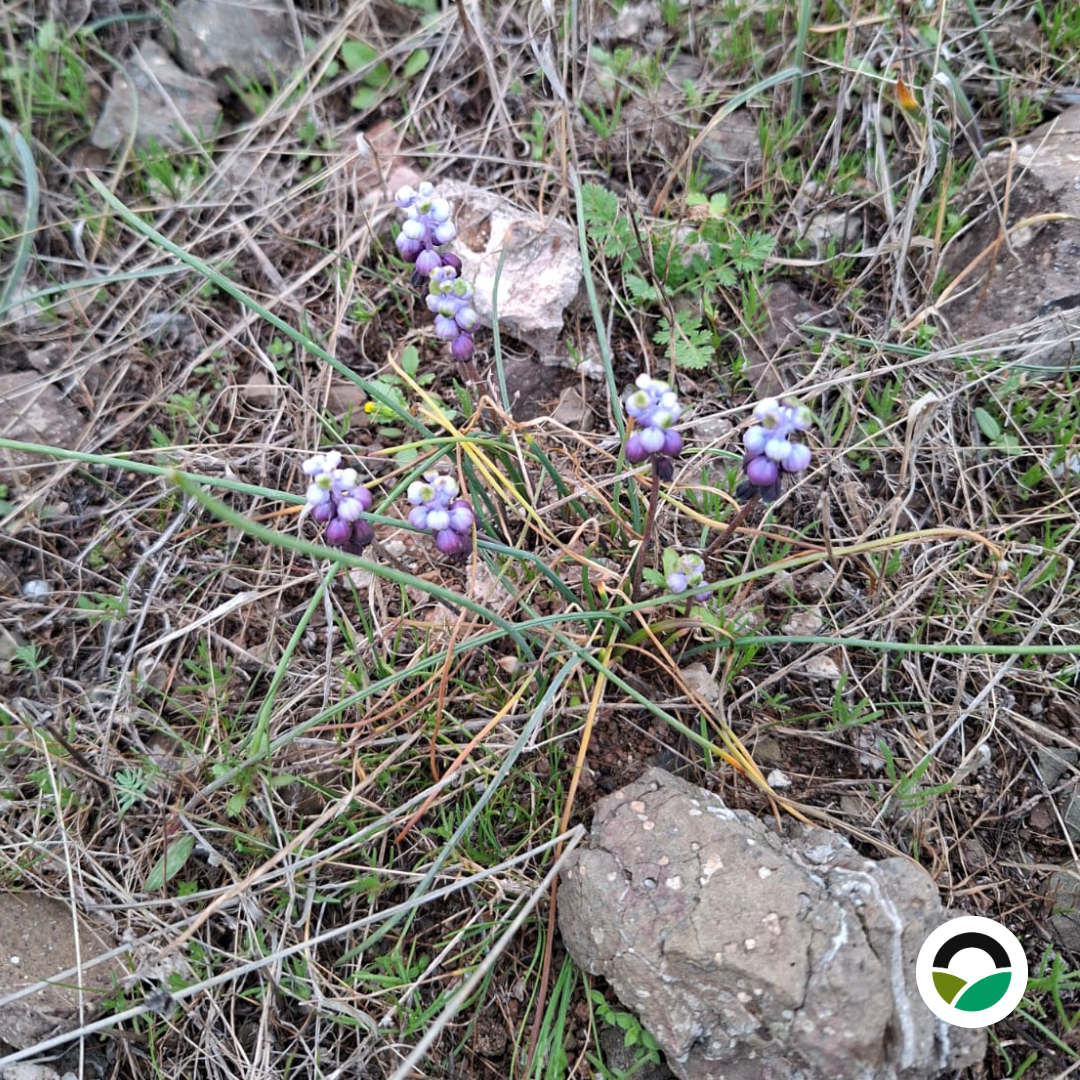
After rainy days, these tiny flowers begin to appear across the landscape. They are very small and easy to miss — so watch your step.
This season, Common Grape Hyacinth (Muscari neglectum) is emerging naturally at Mavronero.
These small seasonal flowers grow close to the ground among grasses, stones, and Mediterranean shrubs. Their deep purple clusters resemble miniature bunches of grapes, which gives them their common name.
Although they are easy to overlook because of their size, they are an important part of the natural seasonal cycle of Mediterranean ecosystems.
Like many Mediterranean bulbous plants, grape hyacinths appear for only a short period each year, responding directly to winter rainfall and favourable temperatures.
Botanical identity
Family: Asparagaceae
Species: Muscari neglectum
Growth form: Perennial bulbous geophyte
Common Grape Hyacinth develops from a small underground bulb that stores water and nutrients during the dry Mediterranean summer.
When winter rainfall returns, the bulb quickly produces narrow leaves followed by a short flowering stem bearing compact clusters of bell-shaped flowers.
Characteristic features include:
- Narrow, grass-like basal leaves emerging in winter
- Dense clusters of purple or blue flowers
- Small bell-shaped florets resembling miniature grapes
- Flowering in late winter and early spring
After flowering and seed production, the aerial parts dry out completely. The plant survives underground as a dormant bulb until the next rainy season.
Habitat and distribution
Common Grape Hyacinth is native to the Mediterranean region and is widely distributed across:
- Greece
- Cyprus
- Southern Italy
- Spain and Portugal
- Turkey and parts of the Middle East
It typically grows in:
- rocky slopes
- open grasslands
- olive groves
- field margins
- Mediterranean shrublands
Traditional agricultural landscapes often provide ideal conditions for these plants, especially where soil disturbance is limited and natural vegetation can coexist with cultivated trees.
Ecological adaptation
Common Grape Hyacinth is strongly adapted to Mediterranean seasonal conditions:
- shallow or rocky soils
- winter rainfall patterns
- high solar exposure
- prolonged summer drought
The underground bulb functions as a survival organ. It allows the plant to store energy during the wet season and remain dormant during the long dry summer typical of Mediterranean climates.
This life strategy is common among Mediterranean geophytes, plants that spend much of the year underground and emerge only during favourable conditions.
Ecologically, grape hyacinths contribute to:
- early nectar resources for insects
- seasonal biodiversity in herbaceous vegetation
- soil protection in open landscapes
Although individually small, populations of these plants can create vibrant patches of colour across Mediterranean terrain.
Seasonal appearance
Grape hyacinths are among the early indicators of spring in Mediterranean ecosystems.
Their flowering is closely linked to rainfall. After winter rains, the bulbs respond quickly and produce flowers while soil moisture is still available.
As temperatures rise and the dry season approaches, the plant completes its reproductive cycle and disappears above ground.
This short but intense life cycle allows the species to thrive in environments where summer drought would otherwise prevent plant growth.
Observing them in the landscape
Because of their small size, grape hyacinths are often missed when walking through natural areas.
They typically grow close to the ground, hidden among grasses and stones. Only when walking slowly and paying attention do their purple clusters become visible.
After rainy days, these tiny flowers begin to appear across the landscape. They are very small and easy to miss — so watch your step.
Curiosities
The genus Muscari includes several species commonly known as grape hyacinths.
Some interesting facts about these plants include:
- The name Muscari derives from the Greek word for musk, referring to the scent of some species.
- Many species are native to Mediterranean ecosystems and adapted to seasonal drought.
- Their underground bulbs allow them to survive long dry summers.
- Several species are cultivated worldwide as ornamental spring flowers.
Despite their popularity in gardens, wild grape hyacinths continue to thrive naturally across Mediterranean landscapes.
Notes from Mavronero
Seasonal plants like these appear quietly after periods of rainfall.
While walking through the landscape, small clusters of purple flowers become visible among stones and grasses. Their presence reflects the natural rhythm of Mediterranean ecosystems, where many plants emerge briefly between winter rain and summer drought.
Encounters like this remind us that biodiversity is often found in the smallest details of the landscape.
Sometimes the most interesting discoveries are also the easiest to overlook.
Sources
Royal Horticultural Society – Muscari species overview
