
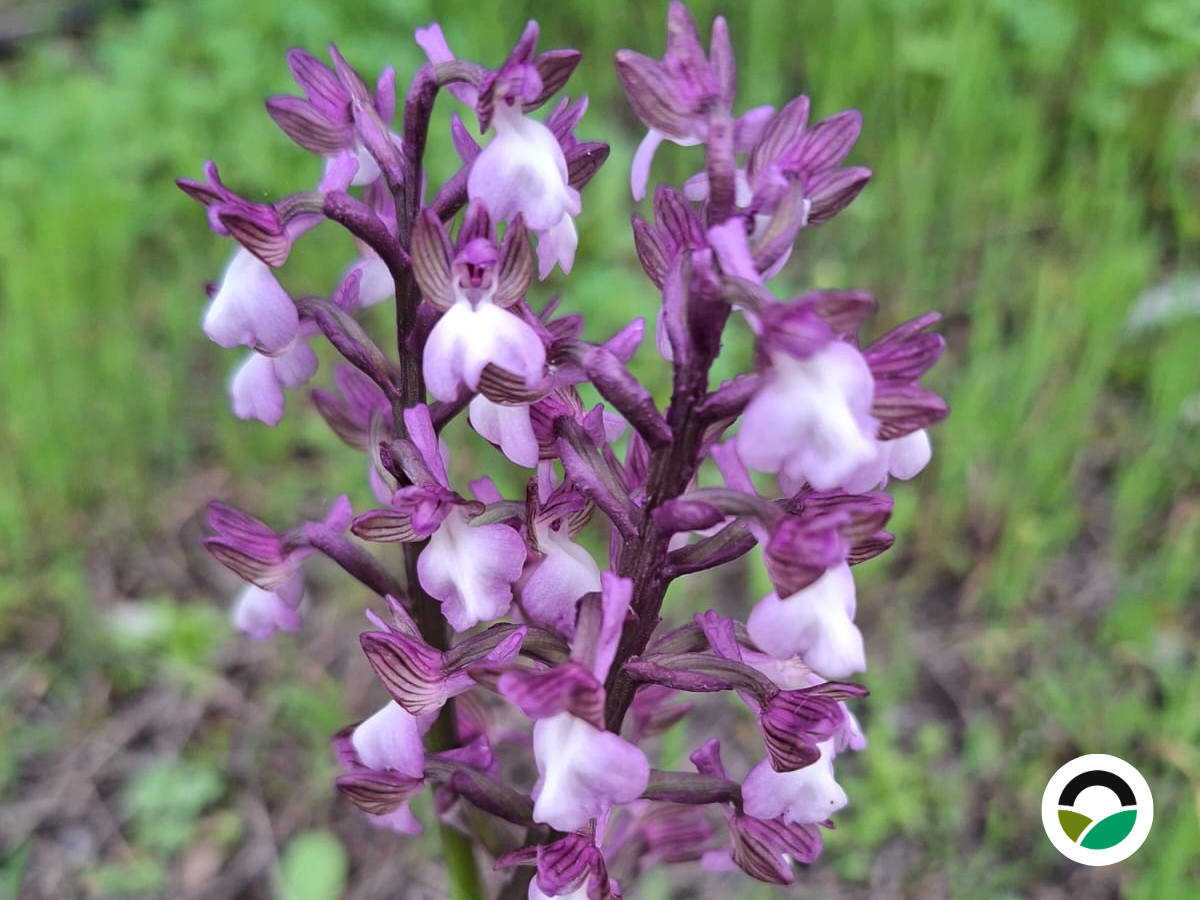
This season, the Green-winged Orchid (Anacamptis morio) has emerged by the old carob tree at Mavronero.
A terrestrial Mediterranean orchid, this species develops in low-input grasslands and open slopes where soil structure and fungal networks remain intact.
Its presence is ecological evidence — not coincidence.
Botanical identity
- Family: Orchidaceae
- Current accepted name: Anacamptis morio
- Former classification: Orchis morio
- Growth form: Perennial terrestrial geophyte
The plant develops from paired underground tubers. During late winter to early spring, it produces basal lanceolate leaves and a dense flowering spike.
Characteristic features include:
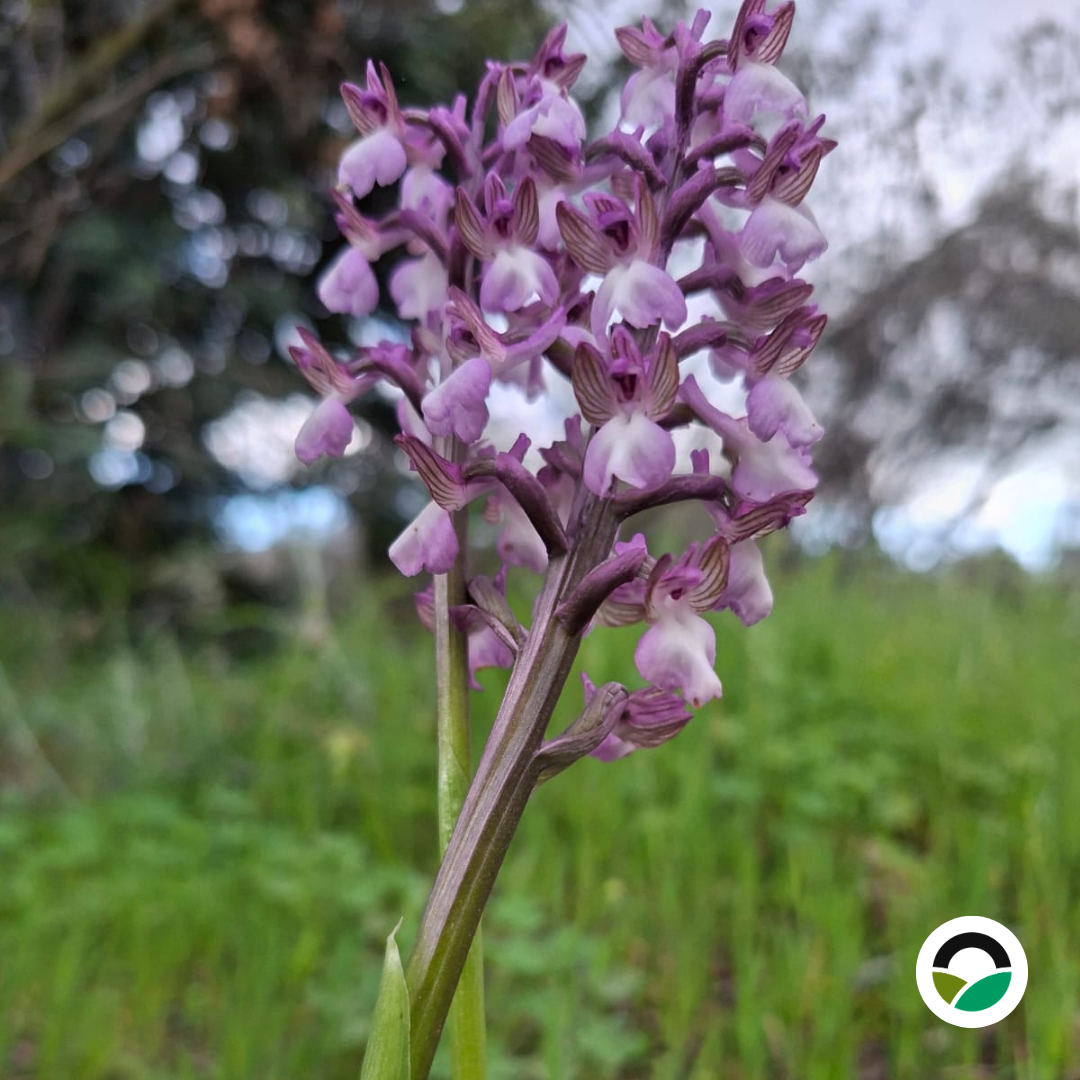
- Purple to pink sepals with distinct green venation (“green wings”)
- Three-lobed labellum with pale central markings
- Compact cylindrical inflorescence
- Spring flowering before summer drought
After seed production, the aerial part disappears completely, and the plant survives underground until the next seasonal cycle.
Soil symbiosis and scientific relevance
The Green-winged Orchid (Anacamptis morio) cannot germinate independently.
Its seeds are microscopic and contain no endosperm. Germination is only possible through symbiosis with specific mycorrhizal fungi that provide carbohydrates during early development.
This dependency means:
- Deep ploughing disrupts establishment
- Excess nitrogen reduces orchid competitiveness
- Soil sterilisation eliminates regeneration capacity
Its presence indicates:
- Functional mycorrhizal networks
- Low fertilisation input
- Minimal soil disturbance
- Ecological continuity over time
From a land management perspective, it behaves as a bioindicator species of semi-natural Mediterranean grasslands.
The setting: by the old Carob Tree
The orchids were observed on a shallow calcareous hillside near the old carob tree.
Carob trees (Ceratonia siliqua) create microclimatic moderation:
- Partial canopy shade
- Organic matter accumulation
- Moisture retention during winter
This microhabitat allows orchids to coexist with grasses and shrubs without intensive intervention.
Comparison with other mediterranean orchids
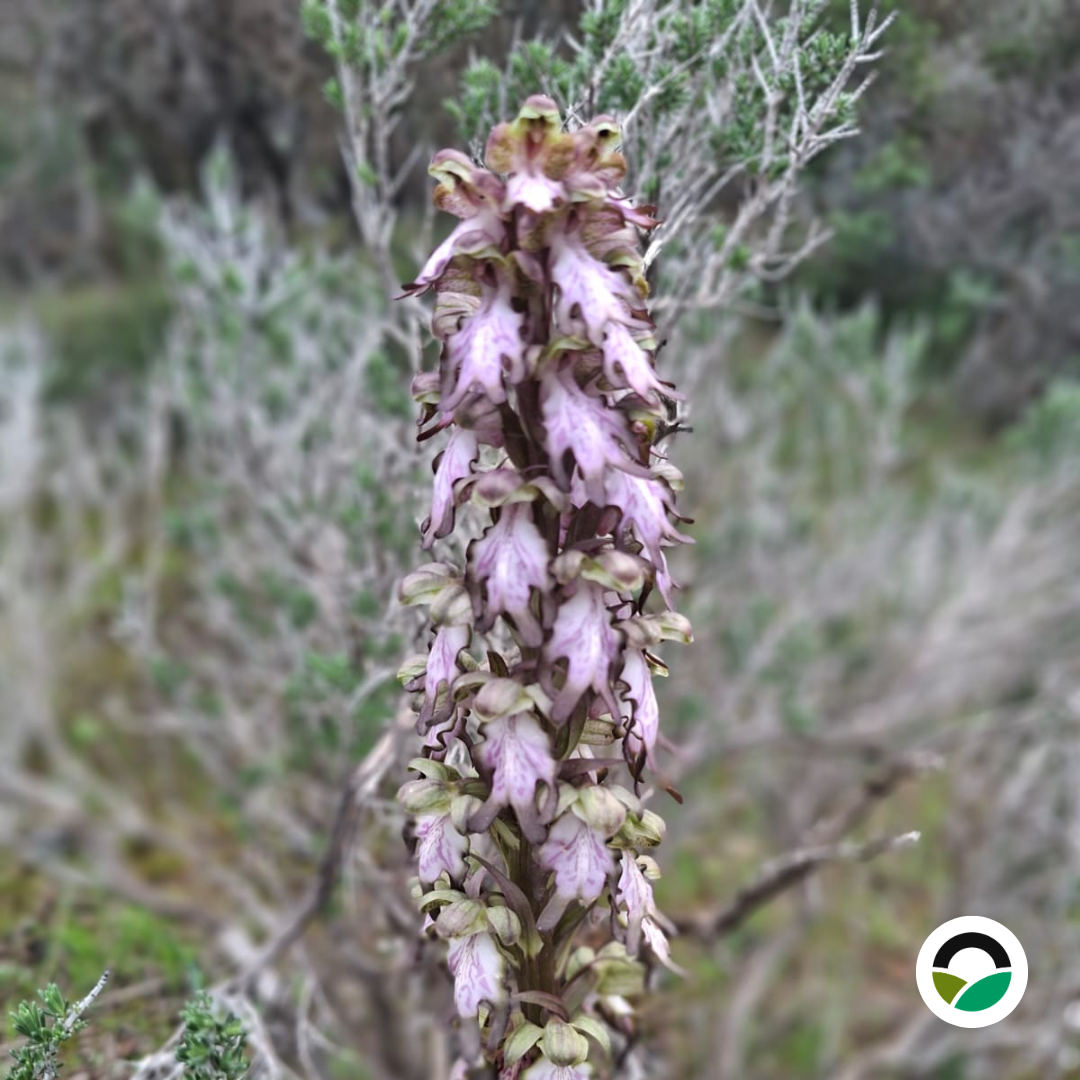
Unlike Ophrys species, which rely on highly specialised sexual mimicry of insects, the Green-winged Orchid uses more generalised pollination strategies.
Compared to tropical orchids:
Green-winged Orchid | Tropical Orchids |
| Terrestrial | Often epiphytic |
| Fungal-dependent germination | Often cultivated in substrates |
| Seasonal dormancy | Continuous growth |
| Climate-adapted | Climate-controlled |
Its resilience lies in adaptation to nutrient-poor, drought-prone systems — not in ornamental performance.
Why it matters
The Green-winged Orchid does not tolerate intensification.
It thrives in continuity.
Its appearance by the old carob tree suggests that the hillside maintains biological integrity beneath the surface.
Small flower.
Complex soil ecology.
Visible resilience.
