
A small frog with a big ecological role
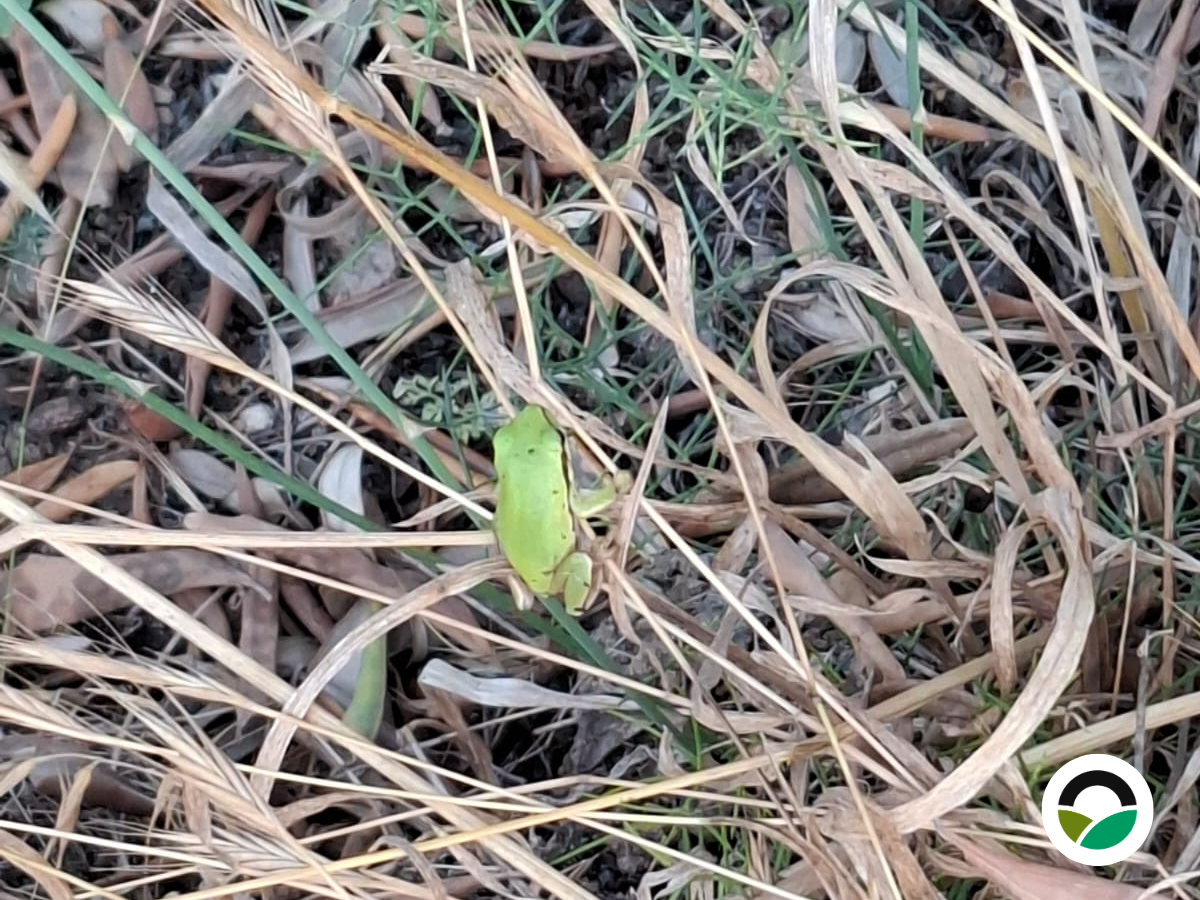
During a recent biodiversity observation at Mavronero Farm, we spotted one of Cyprus’ most charming amphibians—the Middle East tree frog (Hyla savignyi).
Bright green, no larger than a few centimetres, and perfectly camouflaged among grasses and shrubs, this tiny frog is easy to overlook despite being one of the island’s most widespread amphibians.
Completely harmless to humans, it plays an important role in Mediterranean ecosystems by feeding on insects and serving as prey for larger wildlife.
Its presence at Mavronero is another encouraging sign that the farm continues to provide habitats capable of supporting a rich diversity of native species.
What is the Middle East tree frog?
The Middle East tree frog (Hyla savignyi) belongs to the family Hylidae, a group of small frogs adapted for climbing vegetation.
It is native to the eastern Mediterranean and western Asia, including Cyprus.
The species is easily recognised by:
- bright green body colour
- smooth skin
- slender build
- adhesive toe pads for climbing
- dark stripe running from the snout through the eye towards the shoulder
Adults usually measure between 3 and 5 cm, making them one of Cyprus’ smaller amphibians.
Where does it live?
Although tree frogs are often associated with ponds and wetlands, they spend much of their lives away from permanent water.
In Cyprus they can commonly be found in:
- olive groves
- river terraces
- gardens
- shrubs and hedgerows
- reed beds
- agricultural landscapes
- areas close to seasonal streams
They usually return to water only during the breeding season.
An excellent climber
Unlike many frog species that remain on the ground, the Middle East tree frog frequently climbs grasses, reeds, shrubs and low tree branches.
Tiny adhesive pads on its toes allow it to grip smooth surfaces with remarkable efficiency.
Its bright green colour provides excellent camouflage among leaves and vegetation, making it difficult for predators to detect.
During hot summer days it usually hides in shaded vegetation before becoming more active during the evening and at night.
What does it eat?
The Middle East tree frog is an insectivore.
Its diet mainly includes:
- mosquitoes
- flies
- moths
- beetles
- ants
- spiders
- other small invertebrates
By feeding on insects, these frogs contribute naturally to regulating insect populations in agricultural landscapes.
Why amphibians matter
Amphibians are considered among the best indicators of environmental health.
Because they breathe partly through their skin and depend on clean habitats during different stages of their lives, they are particularly sensitive to pollution, habitat degradation and climate change.
Healthy frog populations usually indicate:
- good habitat quality
- diverse insect communities
- functioning food webs
- relatively low environmental disturbance
Their presence therefore provides valuable information about the condition of local ecosystems.
Observations at Mavronero
The individual observed at Mavronero was found resting quietly among dry grasses and low vegetation during the summer.
Although the surrounding landscape appears dry, nearby vegetation, seasonal moisture and abundant insect life create suitable conditions for this adaptable amphibian.
Finding species like the Middle East tree frog reminds us that Mediterranean farms support much more than crops—they also provide habitat for countless native animals.
Living alongside biodiversity
At Mavronero, biodiversity is viewed as an essential component of regenerative farming.
Pollinators, reptiles, amphibians, birds and countless invertebrates all contribute to maintaining resilient ecosystems.
Protecting natural vegetation, reducing chemical inputs and preserving habitat diversity allows these species to continue performing their ecological roles.
The Middle East tree frog is one small example of how wildlife and agriculture can successfully coexist.
Interesting facts
- The Middle East tree frog can change its colour slightly depending on temperature and surroundings.
- Its loud breeding call can be heard over long distances.
- Adhesive toe pads allow it to climb smooth leaves and stems.
- It becomes most active after sunset.
- It is completely harmless to humans.
- It helps regulate insect populations naturally.
- Cyprus is one of the westernmost parts of its natural distribution.
Conclusion
The discovery of a Middle East tree frog at Mavronero highlights the remarkable biodiversity that exists within Mediterranean agricultural landscapes.
Even small amphibians play an essential role in healthy ecosystems, helping regulate insects while contributing to complex food webs.
Every observation reminds us that protecting biodiversity also means protecting the countless species that quietly share the landscape with us every day.
