
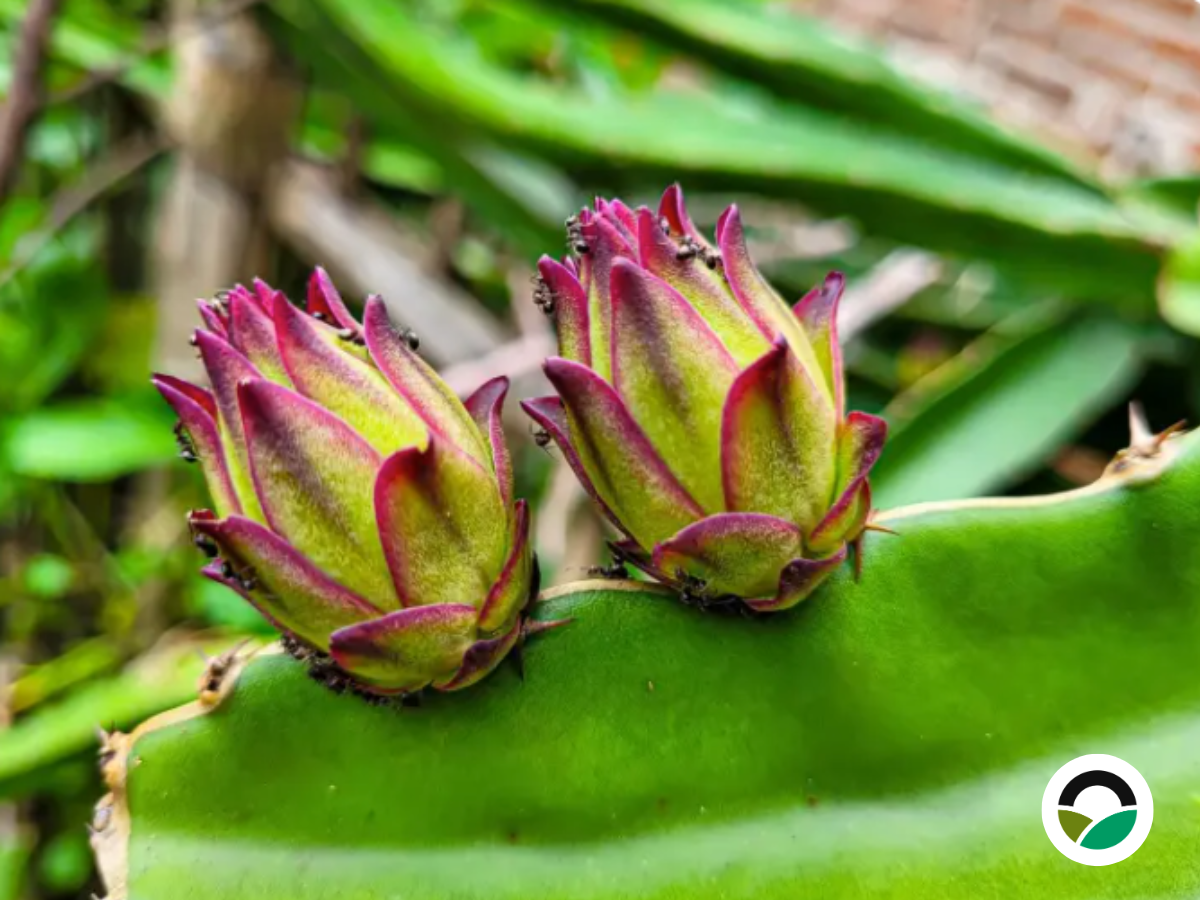
Dragon fruit (Hylocereus spp.) can be successfully cultivated beneath olive trees when the planting conditions are carefully prepared. The partial shade provided by mature olive trees creates a balanced microclimate that protects young plants from extreme heat while still allowing enough light for growth.
At Mavronero Farm, this method integrates fruit production within existing olive groves, making efficient use of space while maintaining soil health and biodiversity.
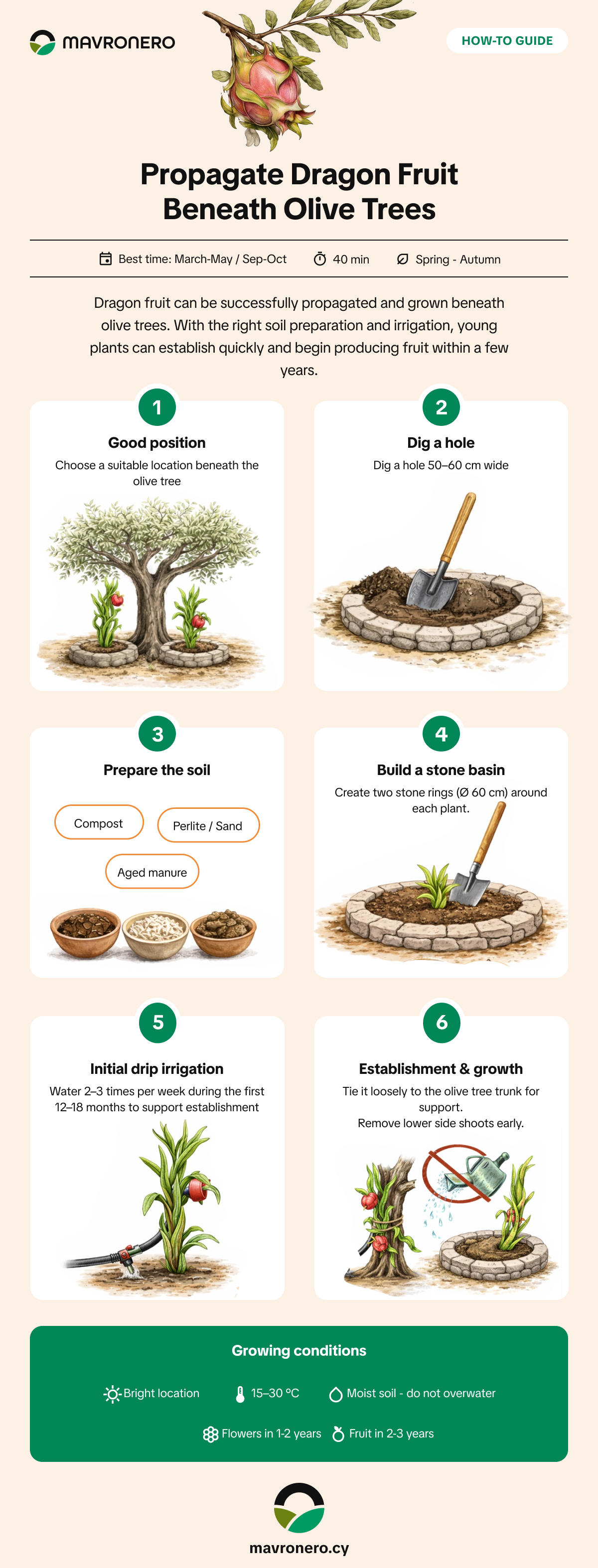
The visual guide below summarizes the basic setup and early management steps.
Visual guide
Step by step explanation
1. Prepare the soil
Begin by preparing a planting hole approximately 50–60 cm wide.
Improve the soil structure by mixing:
- Compost
- Sand or perlite
- Aged manure
This creates a light, well-draining substrate that supports root development while providing sufficient nutrients for early growth.
2. Build stone basin
Construct two stone rings with a diameter of around 60 cm around the planting hole.
This small stone basin helps:
- Retain irrigation water
- Protect the soil from erosion
- Stabilize the planting area
Stone structures are commonly used in Mediterranean farming to improve water efficiency and regulate soil temperature.
3. Initial irrigation
After planting, apply regular drip irrigation during the establishment phase.
A typical schedule is 2–3 times per week during the first 12–18 months, depending on local climate and soil conditions.
Allow the soil to dry slightly between watering cycles to avoid root stress.
Overwatering should be avoided.
4. Establishment and growth
As the plant grows, loosely tie the dragon fruit stems to the olive tree trunk to guide vertical growth.
Early management is important:
- Remove lower side shoots
- Guide the main stems upward
- Maintain airflow around the base
Under good conditions:
- Flowers may appear after 1–2 years
- Fruit production typically begins after 2–3 years
Why this method works
Dragon fruit is a climbing cactus that naturally grows using support structures. Mature olive trees provide a natural vertical framework while also creating a moderated microclimate.
Benefits of this system include:
- Efficient use of existing orchard space
- Natural structural support for climbing stems
- Partial shade that reduces water stress
- Increased biodiversity within the olive grove
This type of polyculture can strengthen ecological farming systems when managed carefully.
Notes from Mavronero
At Mavronero Farm, dragon fruit is introduced as a complementary crop within the olive landscape rather than as a separate plantation.
Planting beneath olive trees allows us to experiment with multi-layer farming systems, where trees and climbing fruit plants coexist and share the same ecological space.
The stone basin technique also helps improve water retention in the dry Mediterranean climate.
Materials used
Typical materials used for this method include:
- Shovel or digging tools
- Compost
- Sand or perlite
- Aged manure
- Natural stones for basin construction
- Drip irrigation system
Further reading
Dragon Fruit Cultivation Guide – University of Florida IFAS
Pitaya Production Manual – FAO Agricultural Resources
Dragon Fruit Growing Systems – UC Agriculture & Natural Resources

Great post! Super useful information