

Pomegranate trees can be propagated reliably from hardwood cuttings taken during late winter. This method allows growers to reproduce healthy trees with the same characteristics as the parent plant.
At Mavronero Farm, we use this technique to expand plantings while maintaining strong, well-adapted varieties suited to Mediterranean conditions.
The visual guide below summarizes the process.
Visual guide
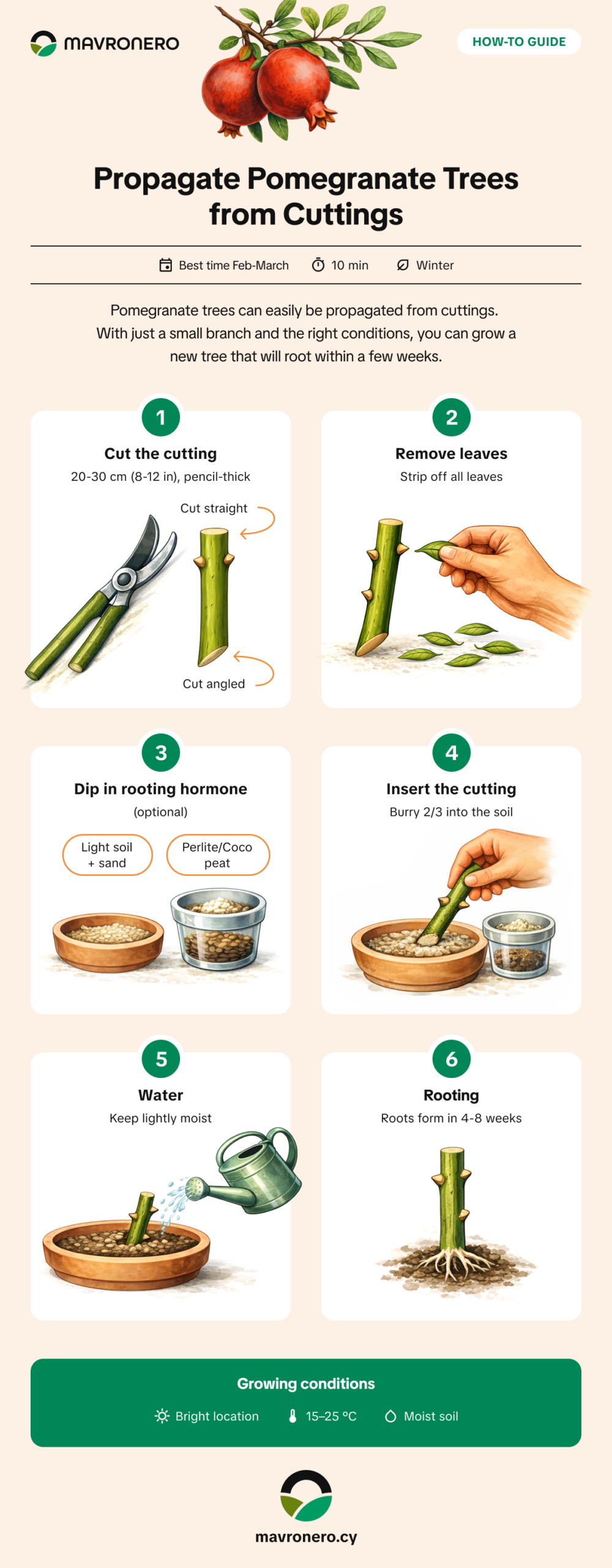
Step by step explanation
1. Cut the cutting
Select a healthy branch from the previous year’s growth.
Cut a section 20–35 cm long (8–12 inches) that is roughly pencil-thick.
Make a clean straight cut at the top and an angled cut at the bottom to easily identify planting orientation.
Use clean, sharp pruning shears to avoid damaging the plant tissue.
2. Remove leaves
Strip off any remaining leaves along the cutting.
This reduces water loss and helps the cutting focus its energy on root formation.
3. Dip in rooting hormone (optional)
Although pomegranates often root successfully without it, dipping the lower end of the cutting in rooting hormone can improve success rates.
Plant the cutting in a light, well-draining substrate, such as:
- Light soil mixed with sand
- Perlite
- Coco peat
Good drainage is essential to prevent rot during the rooting phase.
4. Insert the cutting
Place the cutting into the prepared soil and bury approximately two-thirds of its length.
Ensure the cutting is planted in the correct orientation (angled cut downward).
Firm the soil gently around the base so the cutting stands upright.
5. Water
Water lightly after planting to settle the soil.
Keep the substrate slightly moist, but avoid overwatering. Pomegranate cuttings prefer well-drained soil conditions and excessive moisture may cause rot.
Under suitable conditions, roots typically form within 4–8 weeks.
During this period, place the cuttings in a bright location with temperatures around 15–25 °C. Once new growth appears, the young plant can gradually adapt to outdoor conditions.
Why this method works
Propagation from cuttings allows farmers to:
- Preserve desirable varieties
- Expand plantings efficiently
- Maintain genetic consistency
- Establish orchards with known fruit quality
This technique has been widely used in Mediterranean agriculture for centuries.
Notes from Mavronero
Pomegranate propagation from cuttings is a simple and reliable method for reproducing healthy trees while preserving well-adapted varieties.
At Mavronero Farm, this approach allows us to expand plantings gradually using material from productive trees already growing in the landscape. By propagating from existing trees, we maintain the genetic characteristics of varieties that perform well under local Mediterranean conditions.
This method also reduces the need to purchase nursery plants and helps build orchards that are already adapted to the soil and climate of the farm.
Materials used
Typical materials used for this method include:
• Pruning shears
• Rooting hormone (optional)
• Light soil mix
• Sand, perlite, or coco peat
• Containers or planting beds
Further reading
If you want to learn more about pomegranate propagation and vegetative propagation techniques, these resources provide useful background information:
• Propagation techniques for pomegranate — University of California Agriculture
• Pomegranate cultivation guide — FAO
• Pomegranate propagation and orchard management — Mediterranean Agronomic Institute
