

At Mavronero, winter is a season of quiet activity. While growth slows above the soil, preparation continues beneath the surface — in the land, in the roots, and in the decisions we make as growers.
One such practice is propagating pomegranate trees from cuttings, a traditional Mediterranean method that allows new trees to develop naturally, with minimal intervention.
Why late winter matters
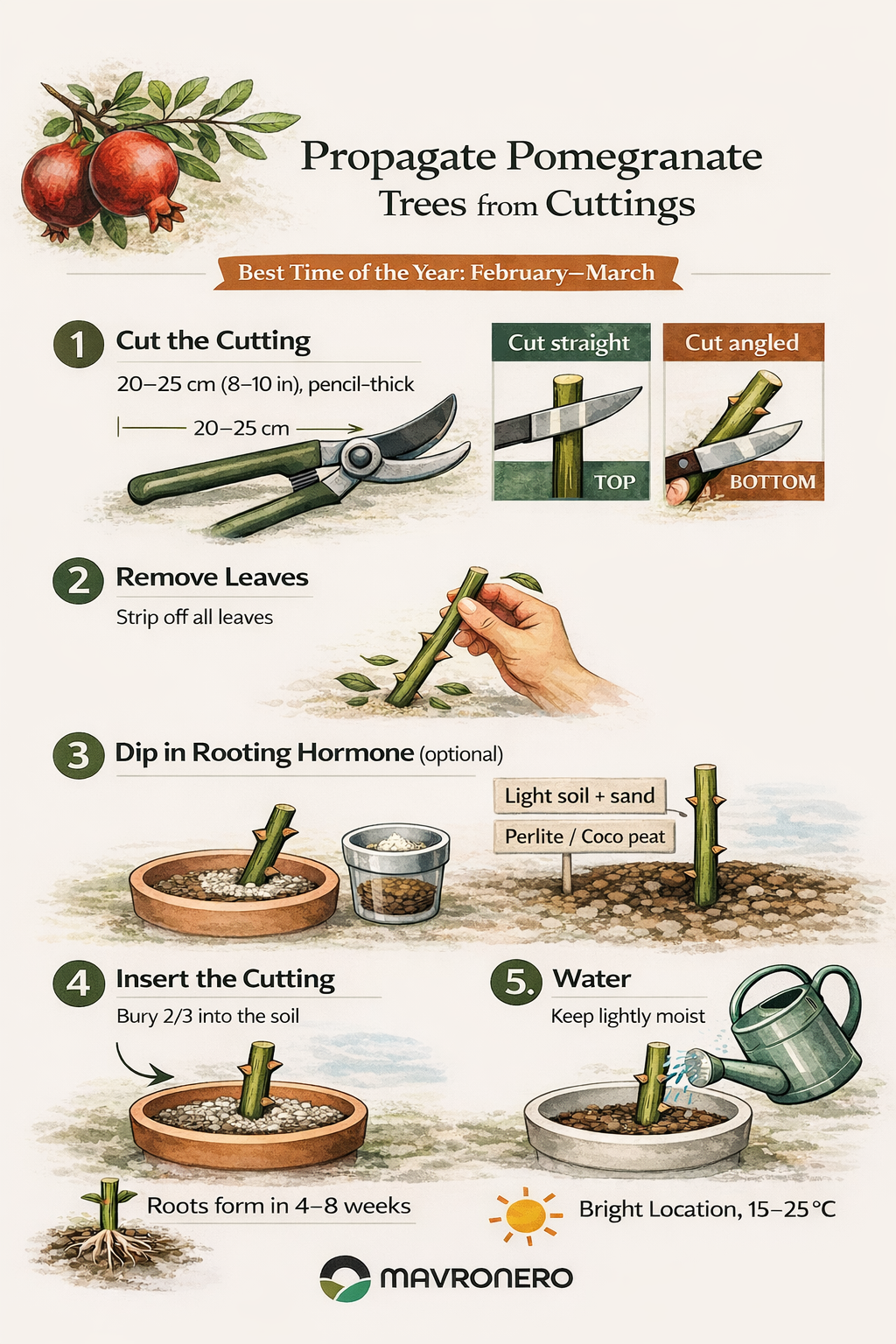
The best time to propagate pomegranate trees is between February and March, when the plant is still dormant but preparing to awaken. Cuttings taken during this period contain stored energy that supports root development once placed in the soil.
This timing reduces stress on the plant and increases the chances of successful rooting.
How propagation works
Healthy, pencil-thick branches are cut to a length of around 20–25 cm. Leaves are removed, and the cutting is placed into light, well-draining soil — often a mix of soil, sand, and perlite or coco peat.
The cutting is buried about two-thirds into the soil and kept lightly moist. No heavy feeding or intensive care is needed. Given warmth and indirect light, roots typically begin to form within 4–8 weeks.
A low-intervention approach
Propagating pomegranates this way reflects a broader philosophy at Mavronero: working with natural cycles rather than against them.
By choosing simple methods, respecting seasonal timing, and allowing plants to develop at their own pace, we support stronger root systems, healthier trees, and greater resilience over time.
Looking ahead
Each cutting represents a future tree — one that will take years to mature, flower, and bear fruit. This long-term perspective is essential in farming and gardening alike.
Propagation is not about speed or volume, but about continuity, care, and trust in natural processes.
