
Nightlife at Mavronero
As the sun sets over Mavronero Farm, a different community of wildlife begins to emerge. While birds settle into the trees and daytime insects disappear, nocturnal predators quietly leave their hiding places.
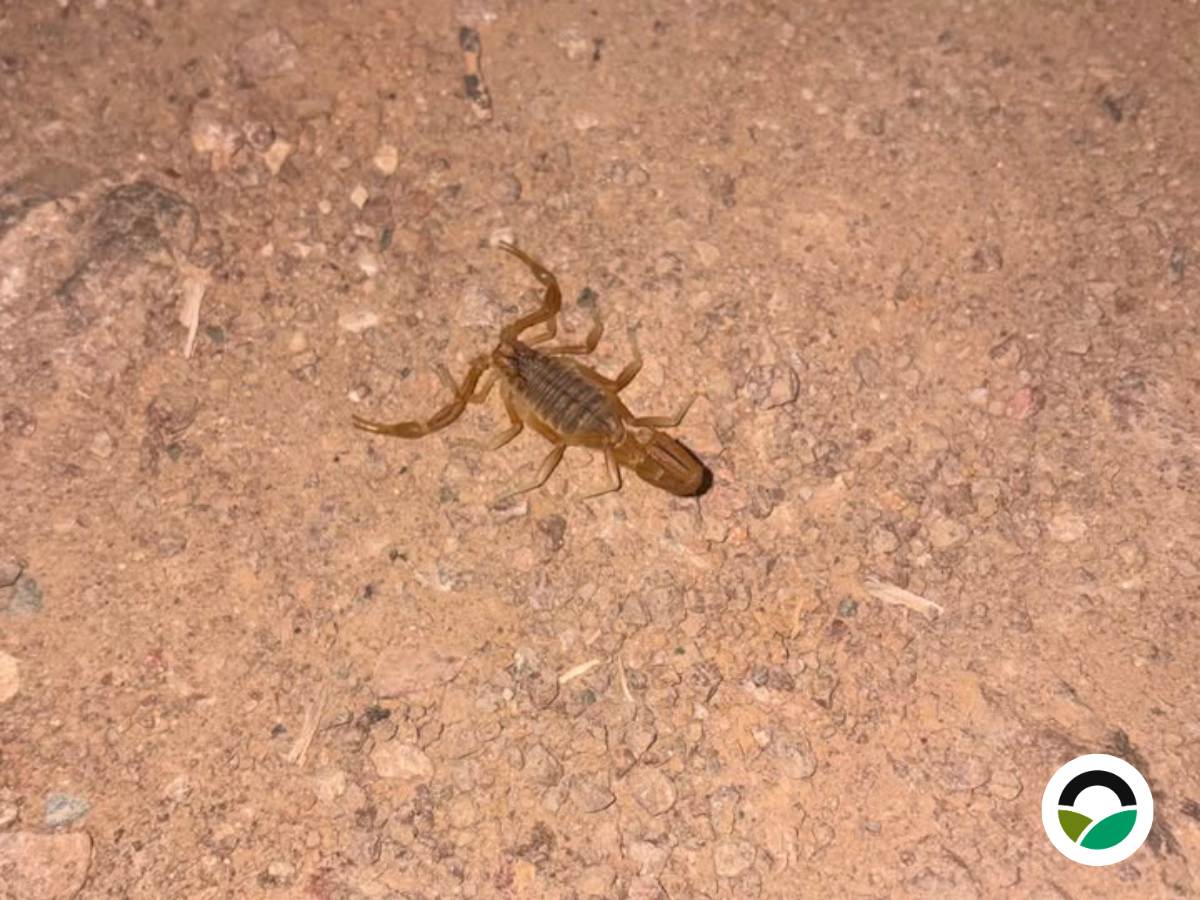
During a recent evening observation, we encountered a small yellow scorpion, one of the species commonly found throughout the dry Mediterranean landscapes of Cyprus.
Although often feared, scorpions are fascinating animals that have survived on Earth for hundreds of millions of years and play an important role in maintaining ecological balance.
What is a scorpion?
Scorpions belong to the class Arachnida, making them close relatives of spiders, harvestmen and mites rather than insects.
They are easily recognised by:
- eight legs
- two grasping pincers (pedipalps)
- a segmented tail ending in a venomous stinger
- a hard external skeleton (exoskeleton)
Scorpions are among the oldest terrestrial predators, with ancestors dating back more than 430 million years.
Scorpions in Cyprus
Cyprus is home to several native scorpion species, most of which are adapted to hot, dry Mediterranean environments.
Yellow scorpions are especially common in:
- rocky hillsides
- dry grasslands
- agricultural land
- olive groves
- river terraces
- stone walls
- beneath rocks and fallen wood
During the day they remain hidden to avoid heat and dehydration.
After sunset, they become active hunters.
Masters of the night
Unlike spiders that rely on webs, scorpions actively search for prey.
Their diet mainly includes:
- crickets
- beetles
- cockroaches
- spiders
- grasshoppers
- small insects
- occasionally other scorpions
Using specialised sensory hairs on their legs, they can detect tiny ground vibrations produced by moving prey.
Once captured, prey is held firmly with the pincers before being immobilised with venom when necessary.
Are they dangerous?
Most Mediterranean scorpions are not aggressive and avoid human contact whenever possible.
Stings usually occur only when the animal is accidentally stepped on, trapped or handled.
For most healthy adults, a sting typically causes local pain and swelling similar to a bee or wasp sting.
However, children, elderly people and individuals with allergies should always seek medical attention after a sting, especially if more serious symptoms develop.
The best approach is simple: observe from a safe distance and allow the animal to continue on its way.
Why scorpions matter
Scorpions are valuable natural predators.
By feeding on numerous insects and other invertebrates, they help regulate populations that might otherwise become abundant.
They also form part of a larger food web, serving as prey for:
- owls
- hedgehogs
- reptiles
- foxes
- certain birds
Their presence is another indicator of a healthy Mediterranean ecosystem with diverse wildlife.
Observations at Mavronero
The individual photographed at Mavronero was observed during a night walk across the farm.
Like many nocturnal species, it remained hidden throughout the day before becoming active after sunset.
Finding wildlife such as scorpions reminds us that biodiversity changes dramatically between day and night.
While most visitors experience the farm during daylight hours, a completely different community of animals becomes active after dark.
Living alongside wildlife
At Mavronero, wildlife is considered an essential part of the agricultural landscape.
Healthy ecosystems include predators of every size—from spiders and scorpions to birds of prey—each contributing to natural ecological balance.
Rather than viewing these animals with fear, we see them as important partners in maintaining biodiversity and reducing insect populations naturally.
Interesting facts
- Scorpions have existed for more than 430 million years.
- They fluoresce under ultraviolet (UV) light.
- They are arachnids, not insects.
- Most species are nocturnal.
- They can survive for long periods without food.
- Their exoskeleton protects them from harsh, dry environments.
- Cyprus is home to several native scorpion species adapted to Mediterranean climates.
Conclusion
Encountering a scorpion at night is a reminder that nature never truly sleeps.
As darkness falls, another world of wildlife begins its daily activities, quietly contributing to the health and balance of the ecosystem.
Observations like these help us better understand the remarkable biodiversity that shares the landscape with us and reinforce the importance of protecting even the species that are often misunderstood.
