

Fig trees can be easily propagated from cuttings during the dormant season. This simple method allows new trees to grow from healthy branches without the need for grafting or complex equipment.
At Mavronero Farm, this technique is used to reproduce strong local fig varieties and maintain productive trees adapted to Mediterranean conditions.
The process relies on selecting healthy cuttings, preparing them correctly, and planting them in well-drained soil where they can develop roots over several weeks.
Visual guide
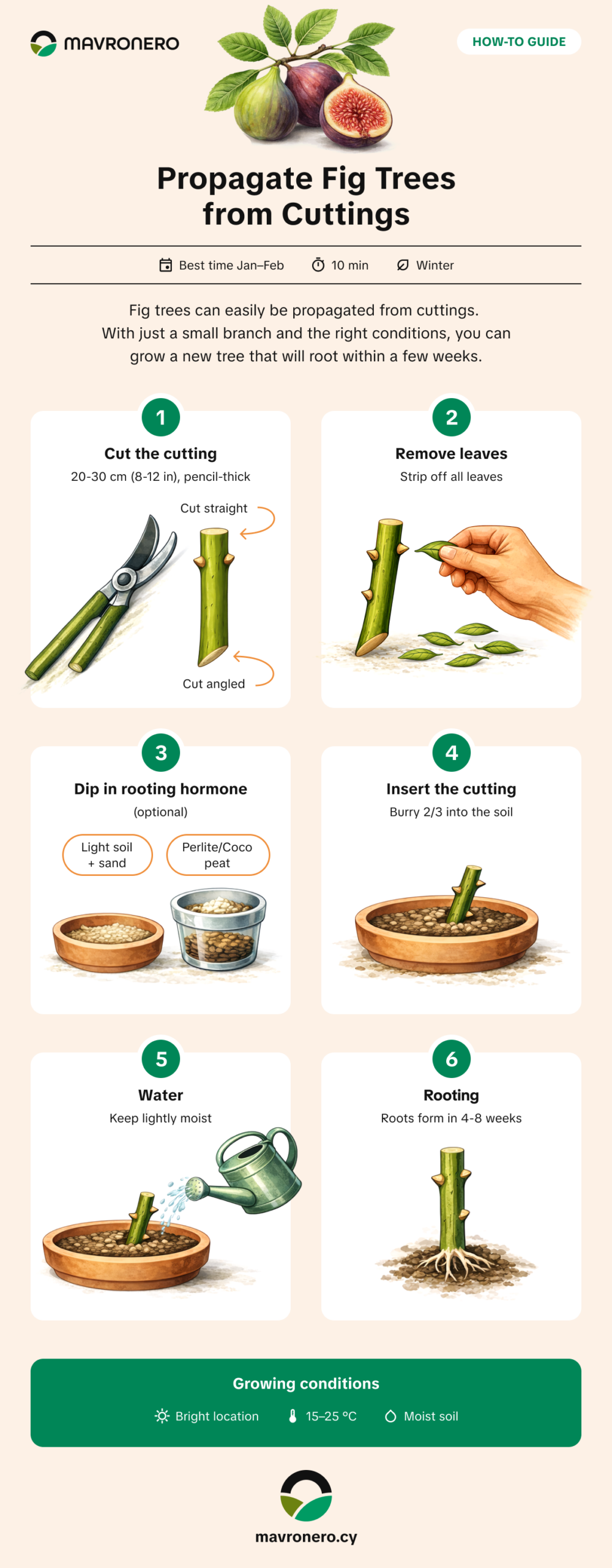
Step by step explanation
1. Cut the cutting
Select a healthy branch during winter dormancy. Cut a section about 20–30 cm long (8–12 inches) with a thickness similar to a pencil.
Make sure the orientation of the cutting is clear:
- Top cut: straight
- Bottom cut: angled
This helps identify which end should go into the soil.
2. Remove leaves
Remove any remaining leaves from the cutting. This reduces water loss and helps the plant focus its energy on developing roots rather than maintaining foliage.
3. Dip in rooting hormone (optional)
Rooting hormone can help stimulate faster root development, although fig cuttings often root successfully without it.
If used, dip the lower end of the cutting into rooting hormone powder.
Suitable planting mixes include:
- Light soil mixed with sand
- Perlite
- Coco peat
These materials improve drainage and root development.
4. Insert the cutting
Plant the cutting in soil, burying around two-thirds of its length.
The soil should be light and well-drained to avoid waterlogging.
Leave the upper buds exposed so new shoots can develop.
5. Water
Water lightly after planting and keep the soil slightly moist, but not wet.
Fig cuttings root best in a bright location with temperatures between 15–25°C.
Under suitable conditions, roots typically develop within 4–8 weeks.
Notes from Mavronero
Fig propagation from cuttings is a reliable method for maintaining local varieties and preserving productive trees already adapted to the farm’s environment.
This approach allows gradual expansion of orchards without purchasing new plants, while keeping the genetic characteristics of the original tree.
Materials used
Typical materials used for this method:
- Pruning shears
- Rooting hormone (optional)
- Light soil mix
- Sand, perlite, or coco peat
- Containers or planting beds
Further reading
If you want to learn more about fig propagation and vegetative propagation techniques, these resources provide useful background information:
- University of California Agriculture & Natural Resources – Fig Propagation Guide
- Royal Horticultural Society (RHS) – Propagating figs
- California Rare Fruit Growers – Growing Figs
- Scientific overview of vegetative propagation in figs (Ficus carica)
These resources provide deeper insight into fig propagation techniques, orchard management, and Mediterranean cultivation practices.
